Listening to Understand

Are you REALLY listening? Unlock hours of productivity with just one simple communication change.

Did you know that a Harris poll recently revealed that the average company loses eight hours of productivity per employee per week due to miscommunication? That tallies to 400 hours per employee per year. At a $100,000 salary, you are losing $20,000 in productivity. The totals are staggering.

Improving communication means providing clearer guidance, using plain language instead of jargon, and listening more effectively. 

I used to think active listening entailed nodding my head and saying “uh-huh” and “yes” every now and again. I probably looked like a kabuki bird or someone with a spring for a neck, and sounded like I couldn’t hold a conversation.

This practice didn’t earn me too many penalties as long as I interacted with someone with the same background and viewpoints.

Others from very different perspectives—whether in graduate school, Afghanistan, or outside the military—would feel that they weren’t being heard. My way of active listening was undermining relationships, impeding coordination, and limiting what we could accomplish.

While nodding and “uh-huhing” at high-level meetings, for example, I was also formulating my responses in my head to the fast-moving and sometimes contentious discussions. When I had it about right and gained a turn to speak, what I said was often out of step with where the conversation had moved. I was also accused of relitigating matters or rehashing what was already agreed, wasting time. 

4 Common Modes of Listening

Frustrated and wanting to do better, I learned that there are four common modes of listening: distracted, listening to respond, listening to win, and listening to understand.

Distracted listening happens when you multitask: reading, typing on your computer, scrolling social media, watching television, etc. You miss most of what the other person is saying, and they feel disrespected by your inattention. 

Listening to respond, what I was doing in meetings, occurs when you hear something that triggers a need to respond, so you stop paying attention to what’s being said while formulating your response. The same part of the brain is involved in both actions, so your internal voice will trump everything else. 

Listening to win entails focusing on proving you are right, undermining the other person, or showing how smart you are. Even if you succeed, you are guaranteed to be on the wrong side of right, making people feel unsafe around you.

Listening to understand improves communication because you focus on getting the other person’s point of view first, especially when you do not agree with them. Provide your full attention so they know nothing is more important at that moment than hearing what they have to say. When they make a point or two, rephrase their position in your own terms and ask, “Did I get that about right?” When they say, “That’s exactly right,” you can move forward.

Exploring their point of view with open-ended questions will show your intention to understand.

  • What inspired you to come to this conclusion?
  • What’s the impact of your observation?
  • How do you suggest we address your point?
  • What makes this matter so important to you?
  • How do you feel about this issue?

Once you’ve gained a more complete perspective, validate their communication by appreciating their willingness to address the matter with you. At that point, you can provide your perspective or point of view and discuss ways to move forward.

RAVEN

The RAVEN acronym can help:

R: Restate their views to their satisfaction

A: Ask open-ended questions

V: Value their willingness to share their views

E: Educate them on your point of view, experiences, or concerns

N: Negotiate a way forward

One executive complained, “Wait a minute, Chris. I don’t have time to do this in every conversation.”

You can’t afford not to because you will save more than the 400 hours per employee you lose annually. As this practice becomes a habit, people will flag problems and bring you new ideas because they know they are being heard, which will reduce time in crisis management and mediocrity while boosting innovation. 

Listening to understand is an investment in success.

I practice these conversations with my coaching clients and during workshops with their teams to help them turn listening to understand into an unconscious competence.

What impact will reducing the unforced miscommunication errors have on your company? Hit reply to let me know.
How to Help People Respond to Failing

Discover how your response to failing can strengthen your leadership and inspire your team.

My boss called me to his office after we finished our live-fire gunnery exercise. My troop excelled – we had the highest scores and a perfect maintenance record. I entered his office expecting congratulations.

“Sit down.”

Uh-oh. This isn’t what I expected.

He told me that one of my mechanics had taken an electronic component from a spare vehicle to repair another without reporting it. That was cheating. 

Instead of a commendation, my boss handed me a letter of reprimand for creating a win-at-all-costs environment, which led to the mechanic cheating. 

I didn’t intend a win-at-all-costs culture, but didn’t emphasize the importance of values as equal to results. His message sank in. 

How Do You Respond to Failing?

“I didn’t fail,” Thomas Edison reportedly said after inventing the light bulb, “I simply found 10,000 ways that don’t work.”

“We cannot let the Afghan Army fail in a battle,” a four-star general told me. “How will they learn to bounce forward?” I replied. U.S. and allied forces bailed them out of every challenging situation. A few years later, the Afghan military collapsed under Taliban pressure when they realized the Americans could no longer come to the rescue – the most expensive failure in U.S. military history.

U.S. Civil War General George B. McClellan succeeded at everything in his life until he commanded the Army of the Potomac. Because everything up to that point came easy for him, he never developed the skills to bounce forward from setbacks. 

When facing the Confederate army at Antietam in September 1862, McClellan sought to protect his ego and avoid failure by wildly overestimating his opponent’s strength, moving slowly despite capturing his enemy’s battle plan, and attacking cautiously when in position to overwhelm and defeat Lee’s army. Lee lived to fight another two and a half years.

General Ulysses S. Grant, by contrast, failed repeatedly in business after being forced out of the Army for over-indulgence. He learned to bounce forward from setbacks and put measures in place to control his alcohol addiction. As a Civil War general, he focused on professional mastery, learning from his mistakes. After a poor performance on day one of the Shiloh battle, General Sherman, Grant’s subordinate, commented on the difficult day. “Yep,” Grant replied, “We’ll lick ‘em tomorrow.” And he did.

Avoiding failure generally means you’ll never succeed. You’re signing up for mediocrity, a slow failure like Sears experienced when they clung to the status quo in the face of an information-age-technology-powered Amazon. 

Mastery or Ego: Understanding People’s Primary Motivation

People’s response to failure is tied to their primary motivation. If you are motivated by ego, like McClellan, you will respond to failure with embarrassment and anger. If you are driven by mastery, like Grant, you will respond with acceptance, learning, and even humor. 

For those focused on mastery, failures lead to learning, innovation, and long-term growth. For those focused on ego, failures lead to finger-pointing, excuses, and defensiveness.

Understanding people’s primary motivation—mastery or ego—is essential so that you hire people who respond to mistakes and failures with resilience instead of blame.

Failing is a normal part of striving for new heights. Encourage it. You only become a failure when you start blaming others.

Do you want to improve how your employees transform setbacks into wins? Schedule a call, and I’ll guide you through the action steps you can immediately implement.

Are You Reacting or Responding?

Here’s how a TSA agent showed me the difference between reacting and responding.

I dropped my bags on the conveyor and headed toward the TSA’s metal detector at the Newark airport on my way home after giving leadership keynotes to executive MBA students. 

Going through the TSA is my least favorite part of travel, especially because of the random inspections, frisking, and yelling. 

Oh, crap. A bell sounded after I passed through the detector, and the TSA agent told me I’d been randomly selected for further screening. Ugh! Here we go again.

That meant going through the body scanner, which always gave me bad results.

Reframing My Perspective

The woman ahead of me complained to the TSA agent about having to endure the body scanner, even though she purchased TSA pre-check.

The agent looked at her partner and said, “I need to switch places with you; I’m out of deep breaths.”

Her admission reframed my perspective. She’s doing her best at a thankless but essential job, enduring comments and complaints throughout her shift. I have to see her once; she has to see thousands of people like me. 

Stepping into the body scanner heightens my heart rate because I know what’s coming next. 

I step out of the scanner, hoping to be on my way, but the agent points to the screen, which shows a red box indicating an area that requires further inspection.

It’s always the same spot. I had a vasectomy years ago. The doctor must have sealed the tubes with metal to prevent them from reattaching.

Managing Emotional Triggers

I’m usually seeing red at this point as the agent explains he’s going to use the back of his hands to check for a crotch bomb, but I’m reminded of what his partner just said.

She developed a way to manage her emotional triggers, using deep breaths to create space between her emotions and reactions. The breaths helped her respond constructively instead of reacting inappropriately. Her next line of defense was to get some distance from the situation, recover balance, and then return in a better state of mind.

Her example showed that I can choose to be angry at this useless frisking or to see it from the agent’s point of view. 

“This happens every time,” I explain, “I had a vasectomy years ago. I’m sure you are just as happy as I am that the doctor put metal in there.” 

He laughed, “Not my favorite thing to do, boss. ” So he did his business, and I went on my way feeling good. 

Mastering your emotional triggers gives you a process to respond rather than react to challenging situations.
 
If you’d like to boost your trigger management skills, the Saber Six Foundation (the nonprofit I founded to help veterans turn post-combat stress into growth) has a terrific program called the 22-Day Trigger Mastery Challenge. Check it out here.

Analyzing the Downstream and Upstream Actions of Secret Service Agents in Protecting Trump

Secret Service breakdown at Trump rally shows the importance of upstream thinking.

I’m appalled by the assassination attempt on former President Trump, and I cannot help but think the violent rhetoric that’s entered our political discourse played a role. I hope people think more carefully before characterizing their opponents in existential terms.

As we get some distance from the event, I wanted to highlight the bravery of the Secret Service agents who did as they trained and protected Trump with their lives. The following bullet, had it been fired, would have hit one of them, wounding or possibly killing them. Thank goodness that did not happen. 

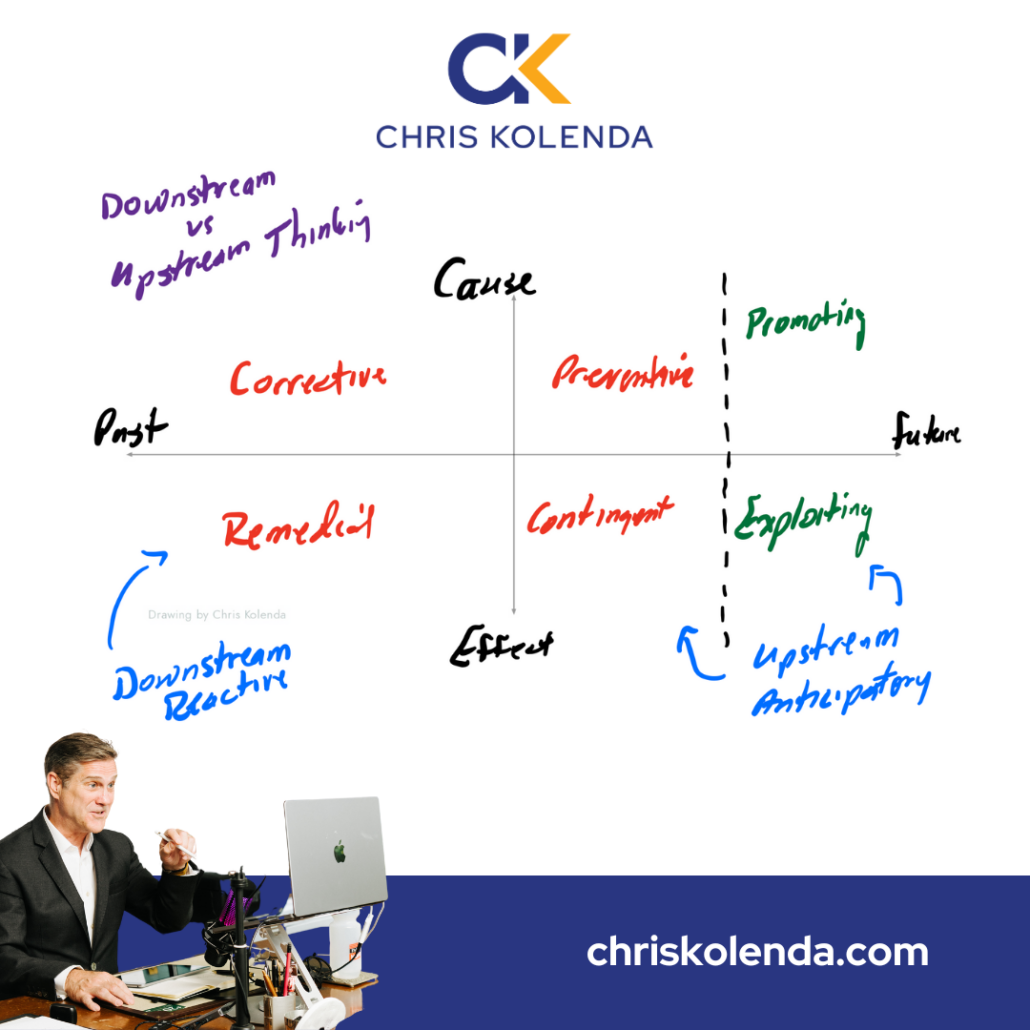
Their actions in response to the event were classic examples of corrective (killing the assailant) and remedial action (protecting Trump). These are downstream actions – reactions to something that already occurred. 

How was someone able to climb up a nearby building with a firearm and set up a firing position without being challenged or interdicted before being able to shoot? People reportedly noticed the assailant and tried to warn authorities for many minutes beforehand.  

Upstream vs. Downstream Thinking

The event suggests the Secret Service’s upstream action was inadequate. Some upstream actions avert adverse events or provide contingencies, while others promote or exploit positive possibilities. 

Preventive action, for example, is designed to prevent something from happening, like providing people with steps to safeguard campfires so they don’t become forest fires. A simple line-of-site tool could show the places with direct sites to the podium so you could place security or surveillance up to a certain distance. Drones could patrol overhead, and counter-drones could keep out intruders. Having security personnel easily identifiable also provides deterrence. 

Contingent actions, which you use to generate options in case a shooter emerges, could include easy reporting protocols (like sports stadiums use for people to report bad behavior), information sharing, and quick reaction forces. I hope an investigation gets to the ground truth and the Secret Service uses the experience to prevent another such attempt.

The takeaway for your business is to create a habit of upstream thinking—crisis prevention is less dramatic than crisis response and almost always less expensive. 

Fortunately, upstream thinking is a learnable skill that I can help you develop. It positions you to reduce risks and exploit favorable opportunities, putting you a step ahead of everyone else. Book a call with me to discuss ways to use upstream thinking.