How to Shorten Your L10 Meetings While Increasing Your Impact

Learn how to transform your L10 meetings into efficient and solutions-oriented sessions.

I used to think that the purpose of meetings was to share important information and boost accountability. Participants highlighted what they achieved and learned; we reviewed stop-light charts and metrics to assess progress and compliance. I grew up participating in such meetings, which seemed normal and practical.

Years later, I looked around the room during a staff meeting. We had around 30 attendees. I listened as they read the PowerPoint bullets from their slides, highlighted the numbers on their charts, and explained any discrepancies.

Why was I having intelligent people read out loud to other intelligent people looking at the same charts? 

A staff member suggested we share the charts in advance and create an agenda focused on solving problems and coordinating solutions. Brilliant! I could free people to do their jobs. We accomplished more in half the time. People saw meetings as valuable instead of soul-sucking. 

EOS L10 meetings suffer from the same problems I was inflicting on my teams.

EOS’s weekly L10 meeting envisions 90 minutes per session. That’s 78 hours of L10 meetings in a year. If you and the ten people in the meeting make an average of $100 per hour, that’s $780,000 invested in these meetings.

What if you cut that number in half? What could you do with 39 hours of additional time?

Cutting that time in half is easy once you take my staff officer’s advice. Use shared documents to convey information and devote your meeting time to making decisions and coordinating solutions. Reading slides or information bullets out loud insults everyone’s intelligence. 

Breaking Down L10 Meetings to Reduce Wasted Time: 4 Steps

Here’s how to break down your typical L10 meeting to reduce wasted time:

Step 1: Gather information asynchronously into a shared document or dashboard.

  1. Weekly Scorecard Metrics. Perfect for a dashboard. Periodically assess them to avoid metric mayhem.
  2. Rock Updates (Rock is EOS jargon for quarterly goals). See above.
  3. To-Do List Updates. Mark completed tasks and provide short comments on any delays in a shared task management tool (e.g., Asana, Trello, or a shared spreadsheet).
  4. Customer and Employee Headlines. Flag items requiring discussion.

Step 2: Prepare the meeting agenda and prioritize the issues for discussion and resolution. Give participants 24 hours to review the agenda and the read-ahead materials.

Step 3: Use the meeting to tackle your top 3 cross-cutting issues. Identify the problem you want to solve, discuss options, and decide. Work on individualized issues separately. Keep the meeting to 45 minutes or less. 

Step 4: Make Commitments. I learned this approach from Robert Cialdini’s book, Influence. Review each item on the to-do list and ask the responsible individual if they can accomplish the task by the deadline. That simple public commitment, Cialdini says, increases compliance dramatically. 

Let me know how this approach works by hitting reply and sending me a quick note. 
The Hidden Accountability Tools Leaders Overlook

Stop Giving Up Your Best Accountability Tools.

“You shouldn’t reward people for simply doing their jobs,” the Deputy Chief said, “It’s like participation trophies – everyone gets one, so they’re meaningless.”

The Deputy is correct, but not for the reasons he assumes. 

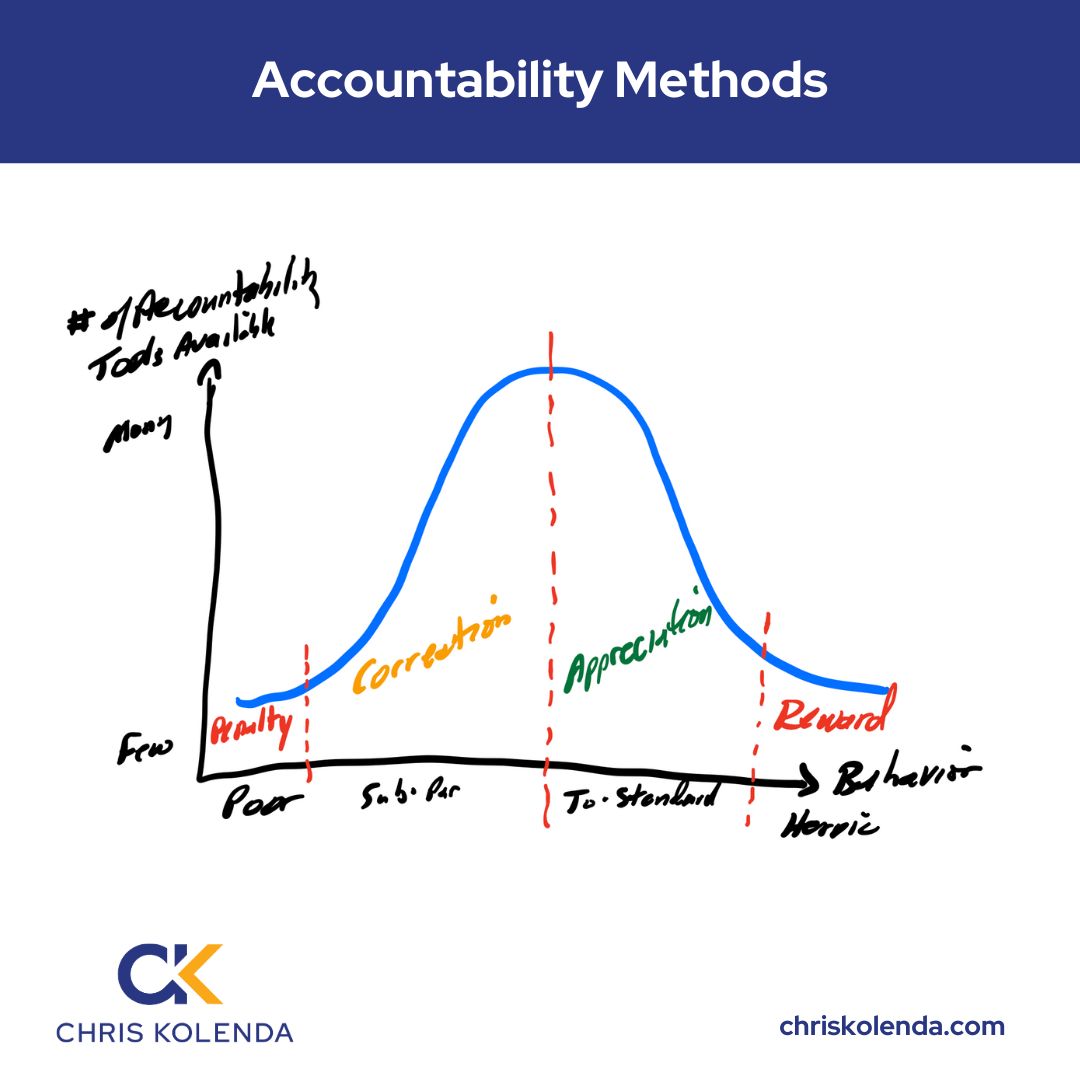
Leaders tend to think of reward and punishment as their primary accountability tools. You reward people for extraordinary performance with bonuses, promotions, and other awards and punish or penalize them for gross standards violations.

This approach addresses only the extremes because the tools are finite and must be used sparingly.

Thus, you leave the critical middle ground—between substandard and subpar—unaddressed, where accountability makes the biggest difference.

Accountability means to be answerable to and for. You are answerable to your bosses, employees, peers, and partners. You are answerable for meeting standards. If used correctly, it’s your primary tool for improving future performance.

Between reward and punishment are two powerful tools in infinite supply: appreciation and correction. You use them to recognize to-standard and address sub-par.

People want to be seen and heard. When you recognize good performance with your appreciation, you encourage that person and everyone around them to repeat the behavior.

When you adjust sub-par behavior by focusing on how to do it better next time, you nip problems in the bud before they become bad habits that require penalties or punishment.

Use this approach:

  1. Appreciation.
    • Recognize the behavior: I saw you doing this; I noticed you doing that, etc.
    • Note the impact: Doing this has had these positive results/benefits/outcomes.
    • Express your appreciation for their contribution.
  2. Correction.
    • Recognize the behavior: I saw you doing this; I noticed you doing that, etc.
    • Note the impact: Doing this has had these consequences.
    • Discuss how to do it better next time. 

Your generous application of these tools will raise your company’s overall performance and attract and retain the right people who buy into your standards.

P.S. This tool is one of the many you will have in your arsenal when you take my trademarked programs: Becoming a WHY Leader®: Six Habits that Inspire People to Contribute their Best and Building an Inspiring Culture®. 

You get the biggest payoff when you use the programs with your direct reports so you are on the same page, can communicate better, and have a standard array of tools to address opportunities and challenges.

Your leader development program must prepare leaders for tomorrow’s challenges, not just today’s. Schedule a call to discuss positioning your subordinate leaders for success.

Leading with Dignity: Mandela’s Lesson for Biden and Us All

Mandela’s leadership was about choosing dignity over power

I spent the past two weeks in South Africa, our final stop being the Apartheid Museum in Johannesburg on June 27th. Mandela’s wisdom and grace inspired me. He negotiated a peaceful transfer of power from the delegitimized apartheid government to one that represented all South Africans and launched the Truth and Reconciliation process that followed.

President Joe Biden’s disastrous debate occurred that evening. The contrast was striking. 

Unlike most developing world leaders who rewrite the rules to stay in control, Mandela stepped down after a single term. 

  1. Commitment to Democracy: Mandela believed sincerely in the principles of democracy and wanted to set a precedent for peaceful and democratic transitions of power in South Africa. By stepping down after one term, he reinforced the importance of constitutional democracy and term limits.
  2. Age and Health: Mandela was 80 years old when he stepped down. Significant factors were his age and desire to spend more time with his family after decades of political and personal struggles.
  3. Leadership Transition: Mandela was keen on ensuring a smooth transition of power. Thabo Mbeki, who had served as his Deputy President, was well-prepared to take over. Mandela supported Mbeki’s candidacy, ensuring continuity and stability for the nation.
  4. Continuing Legacy: After stepping down, Mandela remained active in various social and humanitarian causes. He focused on HIV/AIDS awareness and education through the Nelson Mandela Foundation.

By stepping down, Nelson Mandela underscored his commitment to the principles he fought for and ensured that South Africa’s democracy would be robust and resilient in the years to come.

South Africa certainly has its issues today. The African National Congress has been running the country virtually unopposed since 1994 and has become disastrously corrupt. The problem is so bad that the ANC lost significant power in this year’s election, having to share power with the Democratic Alliance.

I’m grateful to President Biden. He visited my Afghanistan outpost in 2008, and in his speeches, he often refers to his visit to the Kunar River Valley. He even mentioned me and our unit in a 2010 speech at the VFW convention. 

Today, he’s stubbornly clinging to power. Aides and family members have systematically misled the public that everything’s fine and that we should not believe our own eyes that have watched the evident mental and physical decline. The debate showed a naked emperor.

He seems to have surrounded himself with people who will tell him what he wants to hear (you’re the only one who can save us) instead of what he needs to hear (it’s time to step down with a secure place in history and set up an appealing successor to win). 

Who benefits from egging him on?

What’s the upshot for you and me? You need trusted advisors who want what’s best for you and will tell you the truth, including when it’s time for another chapter. 

Departing the scene with dignity, whether by promotion, transfer, or retirement, while setting up your organization to thrive in your absence is among the most significant legacies you can bestow. 

Leaders like George Washington and Nelson Mandela show the way. 

Don’t let your leadership get to this point. Book a call with me so we can create a game plan.

What Surgery Taught Me About Rule-Breaking

How often does rule-breaking occur in your business? Probably more than you’d care to admit.

Americans are avid rule-breakers. I think it’s in our DNA or the water or both. Many people came to America because they didn’t like their home country’s rules. Americans defy scolding self-appointed elites. Don’t tread on me.

We brought the Boston Tea Party, the Declaration of Independence, and a revolution that stirred other rule-breakers into action. During the Cold War, Soviet military officers feared the American military’s unpredictability: “The American military is so hard to understand because they have a doctrine, but they don’t follow it.”

Skepticism about OPR—Other People’s Rules—is pervasive and probably happens more often than you’d like in your business.

I had surgery recently to repair several nose injuries I suffered in the Army that impeded my breathing. (Cue the wisecracks about the lack of oxygen in my brain, which explains a lot.) 

A nurse called before the surgery, giving me all sorts of dos and don’ts: no eating, drinking, or smoking cigars after 9 p.m. the evening before, take a shower, do not apply facial or hair products, etc.

Which of these rules are really necessary? The nurses tend not to explain why, which invites people to push the boundaries. What happens if I take the last cigar puff at 10:30 pm (which I did)? What’s the magic behind fasting for 12 hours before surgery? Why isn’t it six or twenty-four? No water, seriously? Won’t dehydration undermine recovery? What happens if I resort to rule-breaking?

I woke up at 6:30 am, drank the 4 ounces of water left in a bottle, showered (out of respect for the surgeons and nurses), and otherwise maintained my fast.

After slipping on my hospital gown, the anesthesiologist arrived to let me know how they would put me under. He asked when I last had something to eat or drink. I had finished dinner at 7 pm yesterday and drank 4 ounces of water at 0630. 

The time was 8:30, and the doctor said, “Water takes about two hours to run through your system, so we are ok. Some people experience nausea under anesthesia, so we want to make sure your stomach is empty because you can die of suffocation if you vomit.” 

Now I get it. The doctor gave me vivid details on why patients should fast and for how long. If I ever have another surgery, I’ll be sure to stop eating 12 hours beforehand and not drink water two hours beforehand. 

I could deduce the logic behind most rules, but not all of them. People are more likely to skirt the rules when they don’t get the logic. Respect for the rules signals a healthy business, so you want people to follow your standards voluntarily. Buy–in makes accountability much more manageable.

Here’s how you can improve voluntary compliance with your standards:

  • Use the “X so that Y” formula to describe your standards. “Don’t drink water for two hours before your surgery so that you don’t choke on your own vomit from the anesthesia,” for example.
  • If you cannot describe a compelling Y for a given rule, you have good reason to discard or modify it. There’s no reason I couldn’t drink some water early that morning, even though the nurse said nothing after 9 pm. The rule seemed ludicrous, and it was. Resist the urge to add excessive safety buffers, or people will stop taking your rules seriously.
  • When it comes to adding or modifying standards, enlist the people most affected by them in co-creation. People tend not to design self-defeating rules, so that you will have automatic buy-in for co-created ones.
  • Encourage your employees to ask “why” about your standards, which is a good forcing function for you to ensure the Y part of “X so that Y” is compelling. 

When I started asking doctors and nurses the why behind their do’s and don’ts, I got better and more customized responses. 

The best leaders are humble about their rules. Just because you say a given rule is important does not mean people believe you, especially if you don’t obey the rule yourself. 

Make your rules explicit, make them count, and eliminate the ones that have outlived their usefulness.

If you are ready to take your culture to the next level, I have some excellent options. 

First, you can join my Building an Inspiring Culture® program in the self-directed or live-led versions. You’ll receive short, crisp videos, clear step-by-step processes, and implementation assignments to apply the lessons at work.

A workshop is a second option. In it, I will walk you through the tools that build an inspiring culture and help you apply them in ways that work for you and your business.

Finally, an off-site retreat can be a powerful experience for you and your team to strengthen trust, streamline communication, and create shared understanding. My clients love doing them outside at battlefields or national parks.

Turn Your Workplace Values into Standards

Transforming workplace values into actionable standards is more important than you think.

According to a 2024 DDI study, 57% of employees quit their jobs because of their boss, and 37% have considered leaving for this reason. These numbers are not isolated incidents. For example, 50% of employees in a 2022 Gallup study said they left their jobs to escape their manager. 

Turnover costs your company between 50 and 200 percent of the employee’s annual salary. To simplify the math, losing ten employees with a $100k average salary means you are throwing away $500k to $2m.

Managers want to do a good job, and people want to work where they feel appreciated and fit in. What accounts for the gaps?

Your values fail to set standards.

It’s a harsh reality that most company values statements are feel-good slogans that fail to shape behavior. 

What happens in the halls and video calls shines so brightly that your employees cannot see what’s written on the walls. You promote what you permit.

Standards, unlike slogans, clearly define what ‘right’ looks like and what’s unacceptable. They shape behavior, empowering you to create a productive, respectful, and supportive work environment that benefits your company and your employees. 

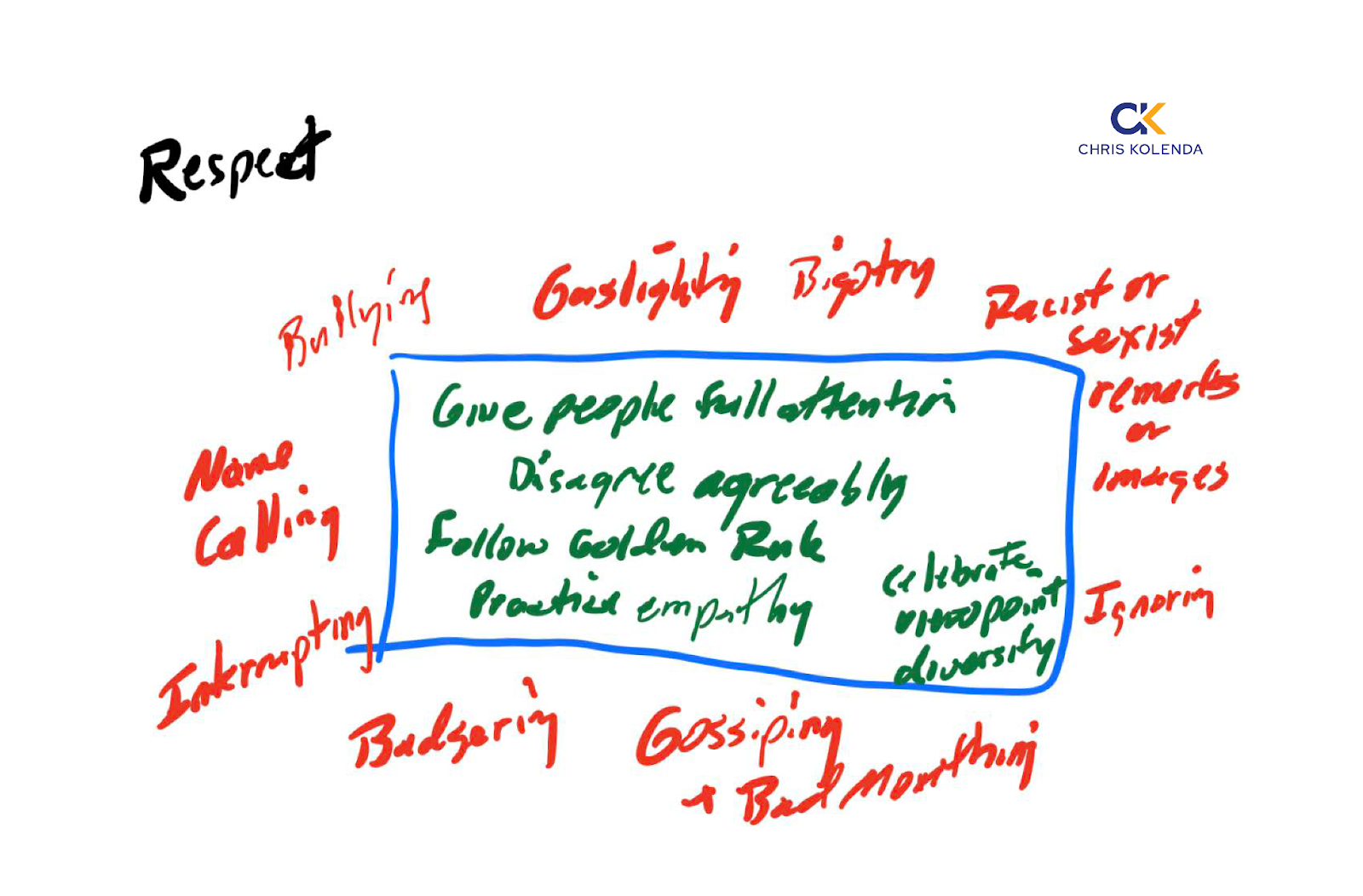
Here’s a simple example using the value of Respect, which a company might define as “We foster a positive work environment because we value our employees.”

There’s nothing wrong with the definition itself, but it provides little clarity on how you want people to behave and why.

Here’s what to do next

Turn the value into a standard using the “X so that Y” formula. 

We foster a positive work environment so that our employees feel valued, speak their minds, treat each other well, and cooperate. A respectful workplace environment encourages people to flag problems, offer fresh ideas, and try new things.

Next, add your standards.

The dance floor can help because it’s a visual that you can co-create with your employees to set clear standards for treating people with respect and defining unacceptable behaviors. Here’s a very simple version:

Finally, provide examples of employees living the values so that people can see themselves meeting the standards.

Susan and Mark had opposing views on building the sales team’s capacity. Susan wanted to boost employee training, while Mark wanted more investment in technology and AI. Instead of bickering, they agreed on a common goal: to improve the sales team’s performance by 20%. Once they created a shared goal, they could examine the best combination of training and technology to boost performance. They co-created options and determined the best way forward, boosting the sales team’s marginal contributions by over 30%.

Standards attract the right-fit prospects and inspire your top talent to stay because people who share the same standards feel like they fit in. 

Imagine what happens when people do not share the same standards. If Susan is an in-your-face “radical candor” enthusiast while Mark prefers agreeable disagreement, one will feel out of place and probably vote with their feet.

If you want your company to soar to new heights, co-create standards for your values and expectations.

Setting standards is part of my latest trademarked program, Building an Inspiring Culture®, which you can take on your own, or we can organize a live-led program for you and your team. 

The program gives you a repeatable, step-by-step process for Building an Inspiring Culture so that you can focus on strategy and growth because your employees meet your standards voluntarily without you having to micromanage. 

You get the practical tools and explicit processes to learn, teach, evaluate, and improve.

Here’s what the program looks like:

  1. Smart Start: Define your Organization’s Common Good
  2. Set Standards: Clarify your Expectations and Values
  3. Gain Buy-in so that people do what’s right voluntarily
  4. Accountability that improves future performance
  5. Build Cognitive Diversity so you make sound decisions and position people for success
  6. Create Psychological Confidence so people flag problems quickly and try new things
  7. How to Address Toxic Behavior so you walk the talk and retain your top talent.

Get the self-directed version here with lifetime access for $997, or hit reply to discuss if a live-led program is a good fit for you and your team.