Building Unshakeable Business Endurance — Lessons From Bill Berrien

What do you get when you combine the discipline of a Navy SEAL, the systems rigor of GE, and the agility of an entrepreneurial CEO? You get Bill Berrien, CEO of Pindel Global Precision. 

In our recent conversation, Bill offered a masterclass in leadership, people development, and decision-making. His insights are especially timely for growth-minded leaders navigating the demanding landscapes of today’s volatile marketplace.

From the SEAL Teams to the Shop Floor

Bill’s transition from Navy SEAL to manufacturing CEO might sound like a hard pivot, but as he explained, the environments share a core DNA. Both demand “highly cohesive, highly trained teams enabled by advanced technology, trying to punch above their weight.” His company, Pindel Global Precision, now in its 78th year, thrives on that ethos.

“When I acquired Pindel in 2012,” Bill said, “we had lower-level technology and a lower-skill workforce. My vision was to invest in tech and train the team to master it. That way, they create more value and capture more value. We’ve had machinists whose wages have doubled or tripled as a result.”

That mindset of linking technology investment to workforce upskilling created a virtuous cycle. The company wins, the customers win, and the employees win.

Professionalizing the Workforce

Manufacturing has long battled a challenge: promoting your best machinist into management often ruins two roles. Bill tackled that head-on by creating three distinct career tracks: engineering, leadership, and high-value production. “Each path is valued, and we train people specifically for the one they choose,” he said. “You’ve got to train them in all paths—not just throw them in and hope they swim.”

For leadership development, Pindel uses a robust yearlong training program that includes monthly instruction, mentoring, and personality profiling. 

“Our professional development program takes pages out of the military’s playbook for NCO and officer development. We use multiple, sequential levels for machinists, quality technicians, and industrial maintenance technicians that put a premium on career-long learning.”

What struck me most is Bill’s critique of a pervasive mindset: the idea that the first 25 years of education should last us for the next 50. “We need to think differently about continuous upskilling,” he said. “Otherwise, we’re letting people fall out of the fight. My motto is: never out of the fight.” You shouldn’t be reduced to trial-and-error for the rest of your professional life.

That’s the heart of Unshakeable Business Endurance: constantly evolving, relentlessly improving, never coasting. Bill’s professional development program is an excellent example of a company’s commitment to lifelong learning.

Boldness in Decision-Making

In uncertain environments, Bill uses optionality to make bold decisions. “We’ve made investments on the knife’s edge,” Bill told me, “and to hedge that, we design optionality into our decisions. The machines can be reconfigured for other parts or customers. We don’t commit 100% upfront, we commit enough to learn and adapt.”

He echoes Jeff Bezos’ concept of Type 1 vs. Type 2 decisions. Type 1s are irreversible; Type 2s offer a way to test, learn, and pivot. “You need to structure decisions to keep some powder dry,” Bill said, “so you’re not boxed in if things shift.”

His advice for other manufacturing leaders? Understand the opportunity’s sensitivities. Build optionality. And, most importantly, build a team with the capacity to pivot with you.

Final Thoughts

Bill Berrien’s leadership journey offers a practical playbook for any CEO or senior leader who wants to build unshakeable business endurance:

  • Invest in technology AND people
  • Build optionality into your decisions
  • Hire and train for the future you want, not just the present you have
  • Stay in the fight, with character and courage
What’s Your Mission Question?

Discover the power of a mission question (and why you need one).

I listened to a podcast interview with Warren Berge, the author of The Book of Beautiful Questions, who suggested creating a mission question.

I’m intrigued by the idea, especially for innovating trailblazers. While a mission statement can focus on what you do today, a mission question expands the horizon for what you do tomorrow. 

Mission Questions That Anticipate Tomorrow’s Needs

In its heyday, Blockbuster’s mission statement was “to be the global leader in rentable home entertainment by providing customers with a wide variety of movies and games, exceptional service, and a convenient, family-friendly experience.”

The statement limited its efforts to rentable movies and games.

Imagine if Blockbuster also had a mission question: How might we best serve the evolving entertainment needs of our customers?

They might not have shut the door on streaming services. A mission question for Kodak might have opened their minds to the possibilities of digital photography.

In a dynamic marketplace like today, you need agility to position yourself to anticipate tomorrow’s needs. A mission question fosters an innovative mindset.

My Mission Question

Here’s my mission question: How might I best help trailblazing CEOs create a decisive competitive advantage so they can make an enduring transformative contribution?

This question inspires me to provide unique perspectives, experiences, content, and visual models to support your business and your aspirations.

I do this in a generalized way with newsletters, blogs, videos, and online programs.

I also support trailblazing leaders like you in a customized way through consulting and events that provide you with the best impact and return on investment.

What’s your mission question?

Strategy Call

Would you be interested in a strategy call about closing the gap between your performance and potential? A strategy call has two main objectives. First, and most importantly, is to deliver value to you. By the time we’re done, you will have gained something of significant value. It might be an idea, some perspective, or an insight into your situation.

Once we’ve had that part of the discussion and you feel that you’ve gotten that value, then we can address if and how I might be able to support you. Does that work for you?

If so, schedule a time that works for you.

Analyzing the Downstream and Upstream Actions of Secret Service Agents in Protecting Trump

Secret Service breakdown at Trump rally shows the importance of upstream thinking.

I’m appalled by the assassination attempt on former President Trump, and I cannot help but think the violent rhetoric that’s entered our political discourse played a role. I hope people think more carefully before characterizing their opponents in existential terms.

As we get some distance from the event, I wanted to highlight the bravery of the Secret Service agents who did as they trained and protected Trump with their lives. The following bullet, had it been fired, would have hit one of them, wounding or possibly killing them. Thank goodness that did not happen. 

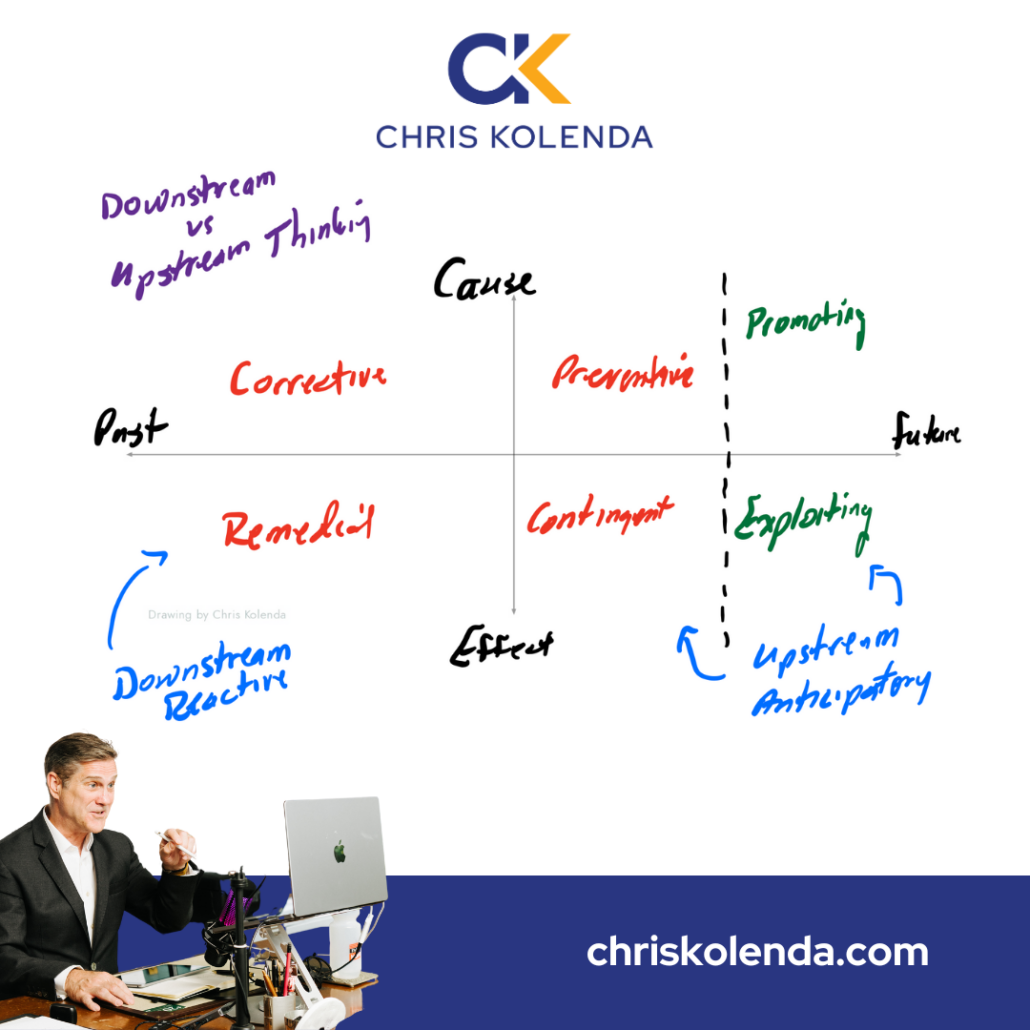
Their actions in response to the event were classic examples of corrective (killing the assailant) and remedial action (protecting Trump). These are downstream actions – reactions to something that already occurred. 

How was someone able to climb up a nearby building with a firearm and set up a firing position without being challenged or interdicted before being able to shoot? People reportedly noticed the assailant and tried to warn authorities for many minutes beforehand.  

Upstream vs. Downstream Thinking

The event suggests the Secret Service’s upstream action was inadequate. Some upstream actions avert adverse events or provide contingencies, while others promote or exploit positive possibilities. 

Preventive action, for example, is designed to prevent something from happening, like providing people with steps to safeguard campfires so they don’t become forest fires. A simple line-of-site tool could show the places with direct sites to the podium so you could place security or surveillance up to a certain distance. Drones could patrol overhead, and counter-drones could keep out intruders. Having security personnel easily identifiable also provides deterrence. 

Contingent actions, which you use to generate options in case a shooter emerges, could include easy reporting protocols (like sports stadiums use for people to report bad behavior), information sharing, and quick reaction forces. I hope an investigation gets to the ground truth and the Secret Service uses the experience to prevent another such attempt.

The takeaway for your business is to create a habit of upstream thinking—crisis prevention is less dramatic than crisis response and almost always less expensive. 

Fortunately, upstream thinking is a learnable skill that I can help you develop. It positions you to reduce risks and exploit favorable opportunities, putting you a step ahead of everyone else. Book a call with me to discuss ways to use upstream thinking.

Leading with Dignity: Mandela’s Lesson for Biden and Us All

Mandela’s leadership was about choosing dignity over power

I spent the past two weeks in South Africa, our final stop being the Apartheid Museum in Johannesburg on June 27th. Mandela’s wisdom and grace inspired me. He negotiated a peaceful transfer of power from the delegitimized apartheid government to one that represented all South Africans and launched the Truth and Reconciliation process that followed.

President Joe Biden’s disastrous debate occurred that evening. The contrast was striking. 

Unlike most developing world leaders who rewrite the rules to stay in control, Mandela stepped down after a single term. 

  1. Commitment to Democracy: Mandela believed sincerely in the principles of democracy and wanted to set a precedent for peaceful and democratic transitions of power in South Africa. By stepping down after one term, he reinforced the importance of constitutional democracy and term limits.
  2. Age and Health: Mandela was 80 years old when he stepped down. Significant factors were his age and desire to spend more time with his family after decades of political and personal struggles.
  3. Leadership Transition: Mandela was keen on ensuring a smooth transition of power. Thabo Mbeki, who had served as his Deputy President, was well-prepared to take over. Mandela supported Mbeki’s candidacy, ensuring continuity and stability for the nation.
  4. Continuing Legacy: After stepping down, Mandela remained active in various social and humanitarian causes. He focused on HIV/AIDS awareness and education through the Nelson Mandela Foundation.

By stepping down, Nelson Mandela underscored his commitment to the principles he fought for and ensured that South Africa’s democracy would be robust and resilient in the years to come.

South Africa certainly has its issues today. The African National Congress has been running the country virtually unopposed since 1994 and has become disastrously corrupt. The problem is so bad that the ANC lost significant power in this year’s election, having to share power with the Democratic Alliance.

I’m grateful to President Biden. He visited my Afghanistan outpost in 2008, and in his speeches, he often refers to his visit to the Kunar River Valley. He even mentioned me and our unit in a 2010 speech at the VFW convention. 

Today, he’s stubbornly clinging to power. Aides and family members have systematically misled the public that everything’s fine and that we should not believe our own eyes that have watched the evident mental and physical decline. The debate showed a naked emperor.

He seems to have surrounded himself with people who will tell him what he wants to hear (you’re the only one who can save us) instead of what he needs to hear (it’s time to step down with a secure place in history and set up an appealing successor to win). 

Who benefits from egging him on?

What’s the upshot for you and me? You need trusted advisors who want what’s best for you and will tell you the truth, including when it’s time for another chapter. 

Departing the scene with dignity, whether by promotion, transfer, or retirement, while setting up your organization to thrive in your absence is among the most significant legacies you can bestow. 

Leaders like George Washington and Nelson Mandela show the way. 

Don’t let your leadership get to this point. Book a call with me so we can create a game plan.

What Surgery Taught Me About Rule-Breaking

How often does rule-breaking occur in your business? Probably more than you’d care to admit.

Americans are avid rule-breakers. I think it’s in our DNA or the water or both. Many people came to America because they didn’t like their home country’s rules. Americans defy scolding self-appointed elites. Don’t tread on me.

We brought the Boston Tea Party, the Declaration of Independence, and a revolution that stirred other rule-breakers into action. During the Cold War, Soviet military officers feared the American military’s unpredictability: “The American military is so hard to understand because they have a doctrine, but they don’t follow it.”

Skepticism about OPR—Other People’s Rules—is pervasive and probably happens more often than you’d like in your business.

I had surgery recently to repair several nose injuries I suffered in the Army that impeded my breathing. (Cue the wisecracks about the lack of oxygen in my brain, which explains a lot.) 

A nurse called before the surgery, giving me all sorts of dos and don’ts: no eating, drinking, or smoking cigars after 9 p.m. the evening before, take a shower, do not apply facial or hair products, etc.

Which of these rules are really necessary? The nurses tend not to explain why, which invites people to push the boundaries. What happens if I take the last cigar puff at 10:30 pm (which I did)? What’s the magic behind fasting for 12 hours before surgery? Why isn’t it six or twenty-four? No water, seriously? Won’t dehydration undermine recovery? What happens if I resort to rule-breaking?

I woke up at 6:30 am, drank the 4 ounces of water left in a bottle, showered (out of respect for the surgeons and nurses), and otherwise maintained my fast.

After slipping on my hospital gown, the anesthesiologist arrived to let me know how they would put me under. He asked when I last had something to eat or drink. I had finished dinner at 7 pm yesterday and drank 4 ounces of water at 0630. 

The time was 8:30, and the doctor said, “Water takes about two hours to run through your system, so we are ok. Some people experience nausea under anesthesia, so we want to make sure your stomach is empty because you can die of suffocation if you vomit.” 

Now I get it. The doctor gave me vivid details on why patients should fast and for how long. If I ever have another surgery, I’ll be sure to stop eating 12 hours beforehand and not drink water two hours beforehand. 

I could deduce the logic behind most rules, but not all of them. People are more likely to skirt the rules when they don’t get the logic. Respect for the rules signals a healthy business, so you want people to follow your standards voluntarily. Buy–in makes accountability much more manageable.

Here’s how you can improve voluntary compliance with your standards:

  • Use the “X so that Y” formula to describe your standards. “Don’t drink water for two hours before your surgery so that you don’t choke on your own vomit from the anesthesia,” for example.
  • If you cannot describe a compelling Y for a given rule, you have good reason to discard or modify it. There’s no reason I couldn’t drink some water early that morning, even though the nurse said nothing after 9 pm. The rule seemed ludicrous, and it was. Resist the urge to add excessive safety buffers, or people will stop taking your rules seriously.
  • When it comes to adding or modifying standards, enlist the people most affected by them in co-creation. People tend not to design self-defeating rules, so that you will have automatic buy-in for co-created ones.
  • Encourage your employees to ask “why” about your standards, which is a good forcing function for you to ensure the Y part of “X so that Y” is compelling. 

When I started asking doctors and nurses the why behind their do’s and don’ts, I got better and more customized responses. 

The best leaders are humble about their rules. Just because you say a given rule is important does not mean people believe you, especially if you don’t obey the rule yourself. 

Make your rules explicit, make them count, and eliminate the ones that have outlived their usefulness.

If you are ready to take your culture to the next level, I have some excellent options. 

First, you can join my Building an Inspiring Culture® program in the self-directed or live-led versions. You’ll receive short, crisp videos, clear step-by-step processes, and implementation assignments to apply the lessons at work.

A workshop is a second option. In it, I will walk you through the tools that build an inspiring culture and help you apply them in ways that work for you and your business.

Finally, an off-site retreat can be a powerful experience for you and your team to strengthen trust, streamline communication, and create shared understanding. My clients love doing them outside at battlefields or national parks.

The Problem with “Servant Leadership”

There are many reasons for increased manager burnout. I want to call attention to a particularly pernicious problem: servant leadership.

Like many people, especially in the military, I regarded “servant” as the highest form of leadership [selfless service is one of the Army’s values.]. 

After all, leading includes service to a higher purpose, the organization, and the people in it. Seventy percent of Fortune 500 companies reportedly say they practice servant leadership.

Well, servant leadership burned me out. 

I was wrong to advance an unexamined piece of conventional wisdom, and I encourage you to rethink it and focus simply on being a good leader.

Do you worry about burnout? You are not alone. According to Harvard Business Review, over 50% of managers feel burned out. 

Burned-out managers exhibit behaviors that degrade their performance, well-being, and the overall health of their teams and organizations. These include:

  • Decreased productivity
  • Increased irritability
  • Poor decisions
  • Self-neglect
  • Lower creativity
  • Less appreciation of employee efforts
  • Increased absenteeism
  • Poor communication

According to Merriam-Webster, a servant is “a person in the employ and subject to the direction or control of an individual or company.” A servant lacks agency. The implications are significant.

Ripe for Abuse. Almost anything goes when “the cause” is the highest good. 

“I want you to stay until 10 pm tonight to work on this presentation.” 

“But it’s my anniversary, and I promised to go to dinner with my wife.”

“I’m sorry about the timing. I really need you to work on this. You are a servant leader in this company, so you have to sacrifice for the greater good.”

Reliance on selfless service and servant leadership is a common way to cover up poor planning, sloppy time management, bullying, and other dysfunctional behaviors.

No Boundaries. As a selflessly serving servant, you have to be “on” at all times. Responsiveness is vital. When your boss texts you at 11 pm on Saturday night, you had better reply within minutes.

Dinner with your family? Storytime with your kids? Softball game? You’d better have your phone ready to answer your boss’s call.

When one of your employees is stressed out, you take on their emotional burdens and workload. You’ll do anything to serve your people.

Constantly prioritizing the needs of others emotionally and physically drains you. That’s what your company demands when they tell you to be a servant leader.

Denial of Self. There can be no self for those who serve selflessly. As a servant leader, you are expected to neglect your own well-being because everyone and everything else comes first. You need to go everywhere, do everything, be everyone for everyone. 

I’ve lived this life, and it costs me and my loved ones. I thought it was the price of being a leader. I tried not to pass on this mentality to my direct reports, encouraging them to set boundaries and take care of themselves, but my personal example sent mixed messages.

Yes, serving is part of leading, but so are requirements like making tough decisions, enforcing standards, and firing people. It can be exhausting, and you need to be vigilant about your capacity and energy to lead the way your company and people deserve and to be the kind of parent, sibling, friend, etc., that your loved ones deserve. 

Here’s What to do instead

Be a leader; forget the label. Use your judgment. Focus on being a good leader who inspires people to contribute their best to your organization’s success. Sometimes, the good of the organization comes first; other times, the needs of the individuals rise to the top. As I note in Leadership: The Warrior’s Art, Be trustworthy, treat people with respect, and be a good steward of your company.

Encourage the Gas Mask Principle. When facing a drop in cabin pressure or a chemical attack, apply your mask before attempting to help others. Otherwise, you put yourself and the person you are trying to help at greater risk. Spend time with your loved ones, sleep, eat right, exercise, and do important things outside of work. Encourage your employees to do the same.

Co-create boundaries that you and your direct reports respect. My mentor, Michèle Flournoy, explained how she and Secretary of Defense Robert Gates did this together and its impact on her and her family. Gates famously left the office by 5:30 pm daily because he knew that staying late encouraged others to do so, even if they had little to do but be seen. 

Provide Perspective. Most matters can wait until the next morning or next week. If you have to write that email tonight to get it off your mind, time it to send tomorrow morning. By sending it tonight, you encourage people to respond tonight. You won’t sprint your way to completing a marathon.

Manage Exceptions. There are rare times when you need that late night. When you respect boundaries and encourage people to take care of themselves and have a life outside their work, they will rise to the occasion when a crisis hits, and you need all hands on deck.

Turn Your Workplace Values into Standards

Transforming workplace values into actionable standards is more important than you think.

According to a 2024 DDI study, 57% of employees quit their jobs because of their boss, and 37% have considered leaving for this reason. These numbers are not isolated incidents. For example, 50% of employees in a 2022 Gallup study said they left their jobs to escape their manager. 

Turnover costs your company between 50 and 200 percent of the employee’s annual salary. To simplify the math, losing ten employees with a $100k average salary means you are throwing away $500k to $2m.

Managers want to do a good job, and people want to work where they feel appreciated and fit in. What accounts for the gaps?

Your values fail to set standards.

It’s a harsh reality that most company values statements are feel-good slogans that fail to shape behavior. 

What happens in the halls and video calls shines so brightly that your employees cannot see what’s written on the walls. You promote what you permit.

Standards, unlike slogans, clearly define what ‘right’ looks like and what’s unacceptable. They shape behavior, empowering you to create a productive, respectful, and supportive work environment that benefits your company and your employees. 

Here’s a simple example using the value of Respect, which a company might define as “We foster a positive work environment because we value our employees.”

There’s nothing wrong with the definition itself, but it provides little clarity on how you want people to behave and why.

Here’s what to do next

Turn the value into a standard using the “X so that Y” formula. 

We foster a positive work environment so that our employees feel valued, speak their minds, treat each other well, and cooperate. A respectful workplace environment encourages people to flag problems, offer fresh ideas, and try new things.

Next, add your standards.

The dance floor can help because it’s a visual that you can co-create with your employees to set clear standards for treating people with respect and defining unacceptable behaviors. Here’s a very simple version:

Finally, provide examples of employees living the values so that people can see themselves meeting the standards.

Susan and Mark had opposing views on building the sales team’s capacity. Susan wanted to boost employee training, while Mark wanted more investment in technology and AI. Instead of bickering, they agreed on a common goal: to improve the sales team’s performance by 20%. Once they created a shared goal, they could examine the best combination of training and technology to boost performance. They co-created options and determined the best way forward, boosting the sales team’s marginal contributions by over 30%.

Standards attract the right-fit prospects and inspire your top talent to stay because people who share the same standards feel like they fit in. 

Imagine what happens when people do not share the same standards. If Susan is an in-your-face “radical candor” enthusiast while Mark prefers agreeable disagreement, one will feel out of place and probably vote with their feet.

If you want your company to soar to new heights, co-create standards for your values and expectations.

Setting standards is part of my latest trademarked program, Building an Inspiring Culture®, which you can take on your own, or we can organize a live-led program for you and your team. 

The program gives you a repeatable, step-by-step process for Building an Inspiring Culture so that you can focus on strategy and growth because your employees meet your standards voluntarily without you having to micromanage. 

You get the practical tools and explicit processes to learn, teach, evaluate, and improve.

Here’s what the program looks like:

  1. Smart Start: Define your Organization’s Common Good
  2. Set Standards: Clarify your Expectations and Values
  3. Gain Buy-in so that people do what’s right voluntarily
  4. Accountability that improves future performance
  5. Build Cognitive Diversity so you make sound decisions and position people for success
  6. Create Psychological Confidence so people flag problems quickly and try new things
  7. How to Address Toxic Behavior so you walk the talk and retain your top talent.

Get the self-directed version here with lifetime access for $997, or hit reply to discuss if a live-led program is a good fit for you and your team.