14 Behaviors That Drain Your Time and Energy

Move away from these behaviors to empower your team, improve communication, and save time.

I used to think that personal and professional growth involved adding more to an already full plate: more objectives, challenges, opportunities, etc. So, I seized upon productivity hacks to do more in the same amount of time. I thought it was the best way to bridge the gap between my performance and potential. 

We used to joke as we trudged up and down mountains in Afghanistan about carrying 200 lbs of lightweight equipment. My life felt like that.

I became super organized and hyper-efficient, but my unforced errors increased, creating rework that added even more to the plate. The quality of my personal interactions diminished as I tried to split my attention between the person in front of me and other tasks I needed to complete. 

I was doing more, but to a lower standard, while getting burned out and losing friends. 

Dr. Mark Goulston helped me to see a different perspective. 

“Do you know what Michelangelo (the famous Renaissance artist) said when he asked how he made David?”

I took away everything that was not David.

Let’s call it the Michelangelo Principle: to begin closing the gap between your performance and potential, remove what’s holding you back. 

One of the most powerful ways is to prune away behaviors that create needless friction. 

Behaviors—how you apply your standards to the people and situations around you—can ease your path to success or create needless friction. 

For people like you at the tail end of the curve, your skills and experiences no longer differentiate you. Your behaviors set you apart. Advance even further into the tail end of the curve by removing your self-inflicted obstacles.

Draining Your Time and Energy: 14 Behaviors

Below are fourteen behaviors that drain your time and energy. Most leaders have two or three of these. Prune these away, and you’ll save hours each week in no longer correcting miscommunication and misaligned work or having to pick up the slack that didn’t need to happen.

1. Adding unnecessary value. When you improve someone’s idea by 5%, you reduce their commitment by 50%. Your employees perform far better with an 80% solution that they own than with a 100% solution you provide. Stop the happy-to-glad.

2. Offering unsolicited advice. Your good intentions can create resentment by saying, “I’m better than you.” Instead, ask what support you can provide to help them succeed faster.

3. Winning every argument. When you insist on winning every argument, you drag out meetings, create unnecessary conflict, and undermine goodwill. Gaining people’s buy-in is more important. Once you’ve got that, shut up and move out.

4. Butting in. Nothing matters before the “but.” The same goes for “however” and “no.” You create resentment with these words that say, “You make a good point, but my point is better than yours.”

5. Providing constructive criticism. Criticism builds defensiveness, which impedes progress. You waste time and energy relitigating the past, and your employees are less likely to innovate and try new things. Stop dwelling on history and start framing a better future by feeding forward: “How will you do it better next time?”

6. Justifying your actions after requesting feedback. You asked for feedback on what you can do better. Your employee tells you something you do that bothers them. When you justify your actions, you imply someone other than you is at fault. They feel they stuck their neck out, wasted their time, and gained your resentment. When you ask for advice and get it, say, “Thank you.”

7. Not listening. Instead of focusing on your employees, you try to multitask. Your employees think they are unimportant to you, and you get only a fraction of what they say. You may listen to respond (see winning every argument), so you miss their more essential points. You waste time and energy on misunderstandings and rework. Focus 100 percent of your attention on listening without passing judgment. Seek first to understand.

8. Speaking (or typing) when angry. You are guaranteed to worsen the situation by creating resentment, putting your foot in your mouth, and piling on problems. Step away from the keyboard, go for a walk, and ask, “What can I do to improve the situation?”

9. Negativity fixation. You want to show how smart you are by explaining why every new idea will fail, so you stifle initiative, undermine ownership, and stay mired in a failing status quo. Ask instead, “How will you address this challenge?”

10. Feeding someone’s negativity fixation. You’ll waste hours arguing back and forth with a know-it-all who’s stuck in their ways. Ask instead, “If it were possible, how would you do it?”

11. Letting perfectionism impede progress. Moving from an 80 to 90 percent solution can be prohibitive regarding time, money, and opportunity cost, so stop waiting for perfection. Go with the 80 percent solution and adapt as needed. You’ll save time, energy, and resources while seizing opportunities that grow your business.

12. Obsessive fault-finding. Some leaders treat finding an error as if discovering a buried treasure. You spend so much time looking for what’s wrong that you miss seeing and recognizing what’s right. You spend time correcting faults but fail to reinforce productive behavior. So, unnecessary problems keep piling up.

13. Finger-pointing. Leaders who obsess over faults tend to fixate on blame. This tendency creates predictable backlash as people try to defend themselves, cover their backsides, and re-litigate the past. While you waste all this time and energy, the cause of the problem remains. Focus on the cause, not blame, address it, and move on.

14. Being the hero. When you parachute to solve everyone’s problems and answer their questions, you become a crutch for your employees. Instead of building self-reliance, you create dependency. You rob yourself of the time to do your job and rob your employer of the value you should provide. Instead of solving the problem for them, ask, “How would you do it?”

Are you ready to slay your time and energy vampires and become an ever-better you? I can help you zero in on the behaviors that close the gap between your performance and potential, revealing your own David. Schedule a call here, and let’s get started.
Analyzing the Downstream and Upstream Actions of Secret Service Agents in Protecting Trump

Secret Service breakdown at Trump rally shows the importance of upstream thinking.

I’m appalled by the assassination attempt on former President Trump, and I cannot help but think the violent rhetoric that’s entered our political discourse played a role. I hope people think more carefully before characterizing their opponents in existential terms.

As we get some distance from the event, I wanted to highlight the bravery of the Secret Service agents who did as they trained and protected Trump with their lives. The following bullet, had it been fired, would have hit one of them, wounding or possibly killing them. Thank goodness that did not happen. 

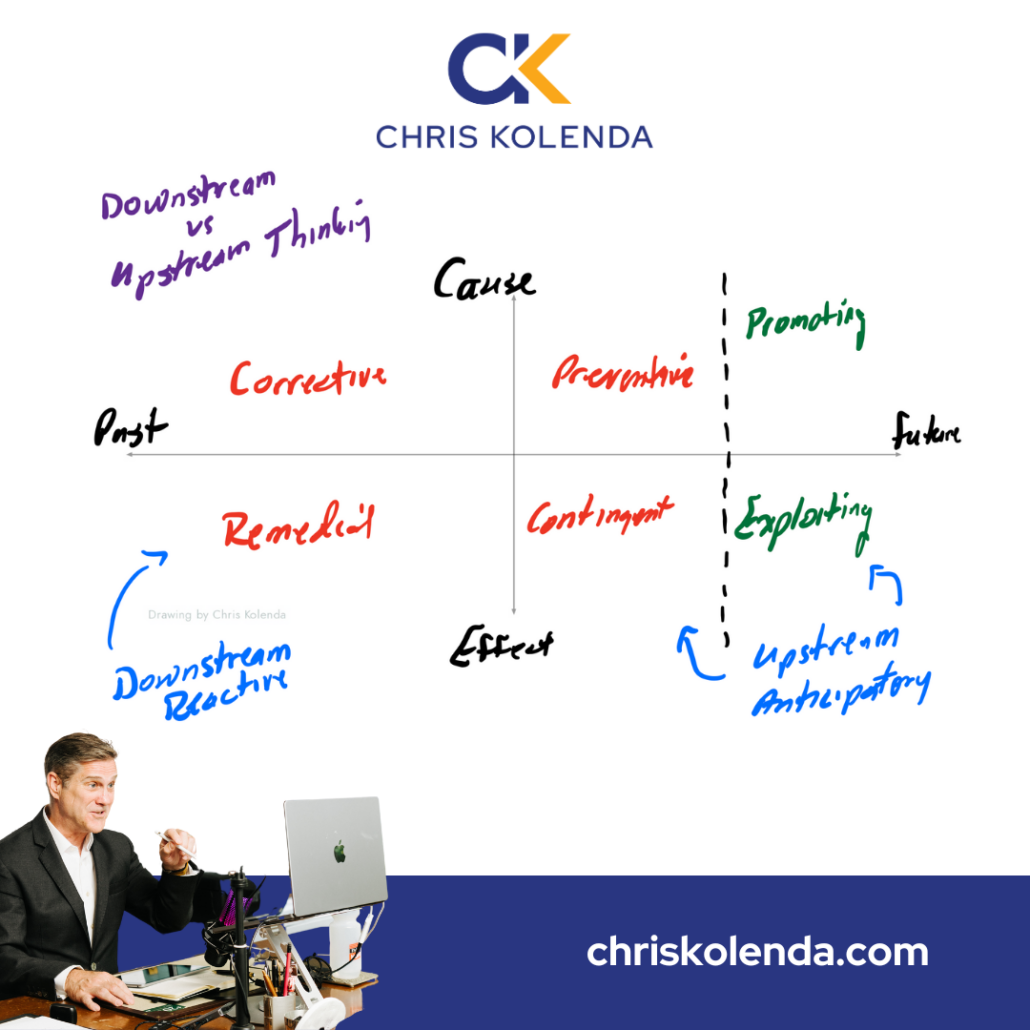
Their actions in response to the event were classic examples of corrective (killing the assailant) and remedial action (protecting Trump). These are downstream actions – reactions to something that already occurred. 

How was someone able to climb up a nearby building with a firearm and set up a firing position without being challenged or interdicted before being able to shoot? People reportedly noticed the assailant and tried to warn authorities for many minutes beforehand.  

Upstream vs. Downstream Thinking

The event suggests the Secret Service’s upstream action was inadequate. Some upstream actions avert adverse events or provide contingencies, while others promote or exploit positive possibilities. 

Preventive action, for example, is designed to prevent something from happening, like providing people with steps to safeguard campfires so they don’t become forest fires. A simple line-of-site tool could show the places with direct sites to the podium so you could place security or surveillance up to a certain distance. Drones could patrol overhead, and counter-drones could keep out intruders. Having security personnel easily identifiable also provides deterrence. 

Contingent actions, which you use to generate options in case a shooter emerges, could include easy reporting protocols (like sports stadiums use for people to report bad behavior), information sharing, and quick reaction forces. I hope an investigation gets to the ground truth and the Secret Service uses the experience to prevent another such attempt.

The takeaway for your business is to create a habit of upstream thinking—crisis prevention is less dramatic than crisis response and almost always less expensive. 

Fortunately, upstream thinking is a learnable skill that I can help you develop. It positions you to reduce risks and exploit favorable opportunities, putting you a step ahead of everyone else. Book a call with me to discuss ways to use upstream thinking.

The Problem with “Servant Leadership”

There are many reasons for increased manager burnout. I want to call attention to a particularly pernicious problem: servant leadership.

Like many people, especially in the military, I regarded “servant” as the highest form of leadership [selfless service is one of the Army’s values.]. 

After all, leading includes service to a higher purpose, the organization, and the people in it. Seventy percent of Fortune 500 companies reportedly say they practice servant leadership.

Well, servant leadership burned me out. 

I was wrong to advance an unexamined piece of conventional wisdom, and I encourage you to rethink it and focus simply on being a good leader.

Do you worry about burnout? You are not alone. According to Harvard Business Review, over 50% of managers feel burned out. 

Burned-out managers exhibit behaviors that degrade their performance, well-being, and the overall health of their teams and organizations. These include:

  • Decreased productivity
  • Increased irritability
  • Poor decisions
  • Self-neglect
  • Lower creativity
  • Less appreciation of employee efforts
  • Increased absenteeism
  • Poor communication

According to Merriam-Webster, a servant is “a person in the employ and subject to the direction or control of an individual or company.” A servant lacks agency. The implications are significant.

Ripe for Abuse. Almost anything goes when “the cause” is the highest good. 

“I want you to stay until 10 pm tonight to work on this presentation.” 

“But it’s my anniversary, and I promised to go to dinner with my wife.”

“I’m sorry about the timing. I really need you to work on this. You are a servant leader in this company, so you have to sacrifice for the greater good.”

Reliance on selfless service and servant leadership is a common way to cover up poor planning, sloppy time management, bullying, and other dysfunctional behaviors.

No Boundaries. As a selflessly serving servant, you have to be “on” at all times. Responsiveness is vital. When your boss texts you at 11 pm on Saturday night, you had better reply within minutes.

Dinner with your family? Storytime with your kids? Softball game? You’d better have your phone ready to answer your boss’s call.

When one of your employees is stressed out, you take on their emotional burdens and workload. You’ll do anything to serve your people.

Constantly prioritizing the needs of others emotionally and physically drains you. That’s what your company demands when they tell you to be a servant leader.

Denial of Self. There can be no self for those who serve selflessly. As a servant leader, you are expected to neglect your own well-being because everyone and everything else comes first. You need to go everywhere, do everything, be everyone for everyone. 

I’ve lived this life, and it costs me and my loved ones. I thought it was the price of being a leader. I tried not to pass on this mentality to my direct reports, encouraging them to set boundaries and take care of themselves, but my personal example sent mixed messages.

Yes, serving is part of leading, but so are requirements like making tough decisions, enforcing standards, and firing people. It can be exhausting, and you need to be vigilant about your capacity and energy to lead the way your company and people deserve and to be the kind of parent, sibling, friend, etc., that your loved ones deserve. 

Here’s What to do instead

Be a leader; forget the label. Use your judgment. Focus on being a good leader who inspires people to contribute their best to your organization’s success. Sometimes, the good of the organization comes first; other times, the needs of the individuals rise to the top. As I note in Leadership: The Warrior’s Art, Be trustworthy, treat people with respect, and be a good steward of your company.

Encourage the Gas Mask Principle. When facing a drop in cabin pressure or a chemical attack, apply your mask before attempting to help others. Otherwise, you put yourself and the person you are trying to help at greater risk. Spend time with your loved ones, sleep, eat right, exercise, and do important things outside of work. Encourage your employees to do the same.

Co-create boundaries that you and your direct reports respect. My mentor, Michèle Flournoy, explained how she and Secretary of Defense Robert Gates did this together and its impact on her and her family. Gates famously left the office by 5:30 pm daily because he knew that staying late encouraged others to do so, even if they had little to do but be seen. 

Provide Perspective. Most matters can wait until the next morning or next week. If you have to write that email tonight to get it off your mind, time it to send tomorrow morning. By sending it tonight, you encourage people to respond tonight. You won’t sprint your way to completing a marathon.

Manage Exceptions. There are rare times when you need that late night. When you respect boundaries and encourage people to take care of themselves and have a life outside their work, they will rise to the occasion when a crisis hits, and you need all hands on deck.

Turn Your Workplace Values into Standards

Transforming workplace values into actionable standards is more important than you think.

According to a 2024 DDI study, 57% of employees quit their jobs because of their boss, and 37% have considered leaving for this reason. These numbers are not isolated incidents. For example, 50% of employees in a 2022 Gallup study said they left their jobs to escape their manager. 

Turnover costs your company between 50 and 200 percent of the employee’s annual salary. To simplify the math, losing ten employees with a $100k average salary means you are throwing away $500k to $2m.

Managers want to do a good job, and people want to work where they feel appreciated and fit in. What accounts for the gaps?

Your values fail to set standards.

It’s a harsh reality that most company values statements are feel-good slogans that fail to shape behavior. 

What happens in the halls and video calls shines so brightly that your employees cannot see what’s written on the walls. You promote what you permit.

Standards, unlike slogans, clearly define what ‘right’ looks like and what’s unacceptable. They shape behavior, empowering you to create a productive, respectful, and supportive work environment that benefits your company and your employees. 

Here’s a simple example using the value of Respect, which a company might define as “We foster a positive work environment because we value our employees.”

There’s nothing wrong with the definition itself, but it provides little clarity on how you want people to behave and why.

Here’s what to do next

Turn the value into a standard using the “X so that Y” formula. 

We foster a positive work environment so that our employees feel valued, speak their minds, treat each other well, and cooperate. A respectful workplace environment encourages people to flag problems, offer fresh ideas, and try new things.

Next, add your standards.

The dance floor can help because it’s a visual that you can co-create with your employees to set clear standards for treating people with respect and defining unacceptable behaviors. Here’s a very simple version:

Finally, provide examples of employees living the values so that people can see themselves meeting the standards.

Susan and Mark had opposing views on building the sales team’s capacity. Susan wanted to boost employee training, while Mark wanted more investment in technology and AI. Instead of bickering, they agreed on a common goal: to improve the sales team’s performance by 20%. Once they created a shared goal, they could examine the best combination of training and technology to boost performance. They co-created options and determined the best way forward, boosting the sales team’s marginal contributions by over 30%.

Standards attract the right-fit prospects and inspire your top talent to stay because people who share the same standards feel like they fit in. 

Imagine what happens when people do not share the same standards. If Susan is an in-your-face “radical candor” enthusiast while Mark prefers agreeable disagreement, one will feel out of place and probably vote with their feet.

If you want your company to soar to new heights, co-create standards for your values and expectations.

Setting standards is part of my latest trademarked program, Building an Inspiring Culture®, which you can take on your own, or we can organize a live-led program for you and your team. 

The program gives you a repeatable, step-by-step process for Building an Inspiring Culture so that you can focus on strategy and growth because your employees meet your standards voluntarily without you having to micromanage. 

You get the practical tools and explicit processes to learn, teach, evaluate, and improve.

Here’s what the program looks like:

  1. Smart Start: Define your Organization’s Common Good
  2. Set Standards: Clarify your Expectations and Values
  3. Gain Buy-in so that people do what’s right voluntarily
  4. Accountability that improves future performance
  5. Build Cognitive Diversity so you make sound decisions and position people for success
  6. Create Psychological Confidence so people flag problems quickly and try new things
  7. How to Address Toxic Behavior so you walk the talk and retain your top talent.

Get the self-directed version here with lifetime access for $997, or hit reply to discuss if a live-led program is a good fit for you and your team.