Tag Archive for: Initiative

The Myth That Kills Initiative

There’s a well-intentioned leadership myth that quietly chokes the boldness out of teams. It sounds responsible. Mature. Even strategic.

“Excellence comes from fixing what’s broken and strengthening best practices.”

If you’re leading a growth-minded team, you’ve probably built a culture of continuous improvement. That’s a good thing.

You track performance. Tighten systems. Solve problems. Reduce friction.

All of that matters.But here’s the trap: when excellence is defined by what’s wrong and how we fix it, you condition your team to look backward instead of forward. They solve problems—yes—but they stop seeking possibility.

Unstoppable workforce graphic and how it relates to initiative.

The Difference Between Continuous Improvement and Inspired Initiative

Let’s break this down.

Continuous improvement is about refinement. It’s vital. You can’t scale chaos.
But it often sounds like:

  • “How can we make this 3% more efficient?”
  • “Let’s eliminate the friction in that process.”
  • “Let’s fix what didn’t go right last quarter.”

You get a smoother machine. Fewer errors. Incremental gains.

Inspired initiative, on the other hand, is a cultural shift. It’s future-facing. Creative. Bolder.
It sounds like:

  • “What if we reimagined this altogether?”
  • “There’s an opportunity emerging that I’d like to exploit.”
  • “Can I take a swing at solving this differently?”

Initiative is where your next breakthrough lives. It’s where your people don’t just do the job, they own the mission.

Why the Fixing Myth Persists

This myth is so sticky because fixing feels smart:

  • It’s measurable. (Bugs fixed. Errors reduced.)
  • It’s safe. (Nobody gets fired for improving a process.)
  • It’s reinforced by most leadership systems. (EOS, Lean, Six Sigma, etc., are built to identify and close gaps.)

Those tools can be powerful when used well.

But if all we reward is compliance and correction, we signal to our teams:

“Color inside the lines. Don’t make waves. Improve, but don’t invent.”

The result?

A culture of careful correctness instead of courageous creativity.

Insight

Improvement makes your systems efficient.

Initiative gives your company endurance.

Nobody ever built a category-defining business by saying, “We fixed more bugs than last year.”

Your best people don’t want to spend their careers just tightening bolts. They want to create, build, and own something that matters.

Questions for the Week

  • Where are you over-investing in tweaks and under-investing in trailblazing?
  • What big ideas are going unexplored because you’re focused on fixing what’s broken?
  • Who on your team is hungry to take initiative, and what’s in their way?

If you’d like a brief diagnostic to assess your team’s position on the Improvement–Initiative spectrum, please let me know. I’ve got a quick tool that can help.

You’ve already built a strong foundation.

Let’s make sure your team isn’t just improving, but initiating.
A D-Day Special: Encouraging Initiative Through History

Celebrating D-Day’s 80th anniversary

“Everyone waits for me to tell them what to do,” Jane told me. “How do I get people to take initiative?”

“Freelancing has burned us before, so I keep people on a tight leash,” Henry said. “We’re making fewer mistakes but too slow to recognize and seize opportunities.”

Jane and Henry show different sides of the challenge. Jane wants people to experiment and try new things, but they are afraid to do so. Henry had people go 100 miles per hour in the wrong direction, wasting time and resources, so he restricted their latitude and now they sit on their hands. He’s not sure how to strike the right balance.

Do you struggle with employee initiative, too? 

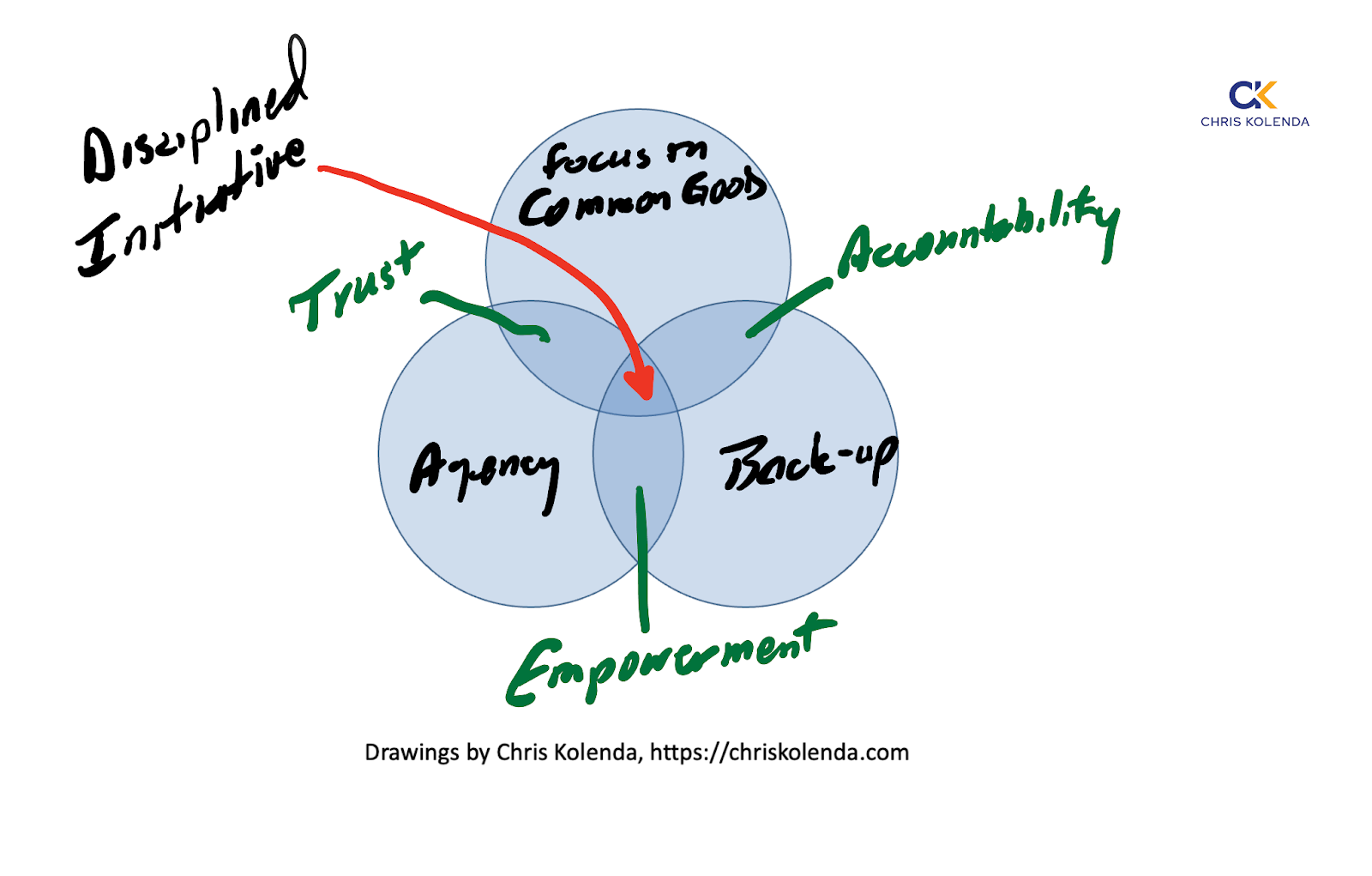
The secret is to promote disciplined initiative, and D-Day’s leader, General Dwight Eisenhower, shows how you can do it, too.

Disciplined initiative occurs when people act on their own accord while advancing your organization’s Common Good (your vision, mission, goals, and standards).

This balance enables them to solve problems, innovate, and seize opportunities without the risk of freelancing, wasting time and energy moving in the wrong direction, and creating more problems than they solve.

The D-Day landings entailed the largest amphibious and airborne assaults in history. Eisenhower had to figure out how to get millions of soldiers and their equipment ashore and sustain them for months as they attacked France toward the Nazi heartland.

Success required innovations like Mulberries (artificial harbors), PLUTO (an oil “pipeline under the ocean”), a massive deception operation to fool the Nazi high command (Operation Fortitude), and the RHINO (blades on tanks to cut through hedgerows). 

Eisenhower also needed leaders who could take situational initiative when plans broke down or new risks or opportunities arose. When the Utah beach landing craft went to the wrong site, Brigadier General Teddy Roosevelt, Jr. had to improvise a new plan. When the 29th division bogged down on Omaha Beach and pummeled by German fire, Brigadier General Norm Cota organized small teams to move out and destroy the bunkers. 

Lt. Gen George Patton’s unique ability to coordinate air support, tanks, infantry, and artillery overwhelmed German defenses and forced their hasty retreat out of France, probably saving Paris from destruction.

How did Eisenhower promote disciplined initiative? He followed the ABCs: Agency, Back-up, and focus on the Common Good.

First, Eisenhower was clear on the Common Good (defeating Nazi Germany) and the strategy to achieve it, which included the planning to achieve the D-Day objectives. He set and enforced explicit standards on matters like cooperation (he famously fired an American Colonel for calling an allied counterpart a “British S.O.B”) and respect (he relieved Patton for assaulting his own soldiers) as well as decision-making and risk. 

Second, he promoted agency by setting explicit boundaries on his subordinates’ authority. Within those boundaries, his generals were free to make decisions (as when Roosevelt improvised on Utah Beach) and innovate. When they got close to a boundary, Eisenhower expected them to report so he could provide more guidance or resources. He avoided second-guessing their decisions, even if he might have done something differently (he avoided micromanaging Montgomery as his operations bogged down near Caen).

Finally, he showed that he had his generals’ backs by taking responsibility for addressing problems and passing credit to his subordinates. When Montgomery’s operations bogged down, and people encouraged Eisenhower to relieve him, Eisenhower instead backed up his general. When pre-D-Day experiments and tests went awry, Eisenhower said he’d address the matters rather than throwing his subordinates under the bus. 

He gave General Bradley and Field Marshall Montgomery the credit for D-Day, even as he penned a letter accepting responsibility if the landings failed.

Encouraging the right behaviors rather than only rewarding success was vital. Toyota does the same thing when encouraging employees to stop the assembly line if they think something is wrong. If there’s nothing wrong, Toyota rewards the behavior rather than criticizing the employee for wasting time and resources. 

Contrast that thinking with how Boeing reportedly handled reports of assembly line problems.

All three elements must be in place for disciplined initiative. Without focusing on the Common Good, you risk freelancing and wasted energy (like Henry experienced). Without agency, people will sit on their hands (Jane had this challenge), and without backup, people will fear being thrown under the bus if a new idea doesn’t work. 

When all three work together, you have Trust, Empowerment, and Accountability. People will report problems, offer fresh ideas, and try new things. They will take action to address unforeseen risks and opportunities, solve problems rather than live with them, and act in ways that shorten the path to success. 

For more on Disciplined Initiative, see Chapter 5 in my book Leadership: The Warrior’s Art or schedule a time to meet. 

P.S. Is visiting the D-Day beaches on your bucket list? I’m hosting a trip for leaders and spouses there, October 11-14. Email or DM me for more information.