Tag Archive for: Success

Performance and Potential: Closing the Gap

Closing the gap between your performance and potential requires breakthrough experiences.

I used to think I could figure everything out and lone-wolf my way to success, but I could never close the gap between my performance and the potential I knew I had. 

It was frustrating. I tried reading books, watching videos, and listening to free advice that often told me conflicting things. After some early wins, my business stagnated as people lost interest in Afghanistan. 

I was going nowhere fast, wasting time and energy, and increasing the risk of failure.  

I was also doing a lot of pro bono peace-building work when I began using a movie analogy to illustrate the importance of showing people the path they cannot see for themselves.

Did you see Indiana Jones and the Last Crusade? 

Searching for the holy grail, Indy discovers the Book of Knowledge, which leads him through various obstacles to his goal. However, a vast canyon stands between him and the grail. The book tells him to take a leap of faith, so Indy steps into the gap and lands on an invisible bridge. He crosses it, then throws sand onto the bridge to illuminate it for others.

We had to illuminate the bridge that others could not see.

It was the same problem for my business, and I needed a dose of my own medicine.

Crossing the gap between your performance and potential requires a guide who can illuminate the path and help you overcome obstacles along the way. 

Content has always been my comfort zone. I knew that business development was vital, but I did not know how to market without self-promoting or sell without coming across as pushy or awkward. I believed that my content would market and sell itself.

Well, it didn’t.

I read books on marketing and sales, but I needed help applying the ideas in ways that worked for me. 

I knew where I wanted to go and what to do to get there, but I didn’t know how. I could not close the gap between my performance and potential.

It was time to invest in myself with people who could illuminate the bridge.

Sure, I could have figured things out eventually, but why waste the time, effort, and frustration in the trial-and-error hamster wheel? I could spend years discovering the right-fit practices on my own, but the right support would reveal them in days, weeks, or months. 

There’s no I-figured-everything-out-on-my-own merit badge, only lost opportunities.

Illuminating the Bridge

This chart represents the difference between your performance and potential. Your will and capacity (skill) govern your performance and create a comfort zone.

The outer band represents your potential – you can reach new heights and know the possibilities.

In between the two is the discomfort zone. It’s shrouded in fog and filled with obstacles, minefields, and frenemies. You fear this is where people watch you fall on your face, so you reinforce your comfort zone and convince yourself it’s good enough.

Fear of the discomfort zone is why so many talented people never reach their potential. 

You can also see the trial-and-error perils that await those who insist on figuring out everything themselves. 

Finding your version of Indiana Jones illuminates the bridge from performance through discomfort to potential. A breakthrough experience shows you your path forward. You still have to make the journey and deal with the hazards, but you have a partner alongside who’s made the journey and helps you deal with them in the most fitting ways.

Alan Weiss helped me develop my business in ways that worked for me and felt good. Chuck Kyle, my cycling coach, kicked my butt training for 18 months and helped me make the vital adjustments I needed to complete a 1700-mile bicycle ride to honor the six soldiers from our unit killed in Afghanistan. 

They illuminated the bridge to get me where I needed to go.

Here’s the beauty of it all. When you reach the potential you always knew you had, you discover further potential and a new adventure to realize it.

Are you ready to break through your comfort zone and achieve the outcomes you deserve? If so, it’s essential to find the right fit for you.

2 Breakthrough Experiences

I’ve got two breakthrough experiences I’d like to share with you: one for CEOs and one for professional services entrepreneurs.

For CEOs: the Antietam & Gettysburg experience gives you new tools and stories to make pivotal decisions, create the supportive culture your company needs to thrive, and the leadership behaviors that gain buy-in and accountability. You’ll enjoy this breakthrough experience with other extraordinary CEOs and build lasting, mutually supportive bonds.

For professional services entrepreneurs: the December 11-13 Business Strategy Breakout Program is an intimate, hands-on, roll-up-your-sleeves, work-on-your-business, and get-results summit for coaches, consultants, experts, thought leaders, and other game changers. Its goal is to help you close the gap between your performance and potential—and realize even greater potential—without sacrificing your lifestyle and commitments in the process.

If one of these opportunities feels right for you, let’s have a meaningful conversation to make sure it’s a good fit. We’ll discuss your performance and potential, and I’ll give you action steps that start closing the gap, whether or not we decide to take the next step.
The Problem with “Servant Leadership”

There are many reasons for increased manager burnout. I want to call attention to a particularly pernicious problem: servant leadership.

Like many people, especially in the military, I regarded “servant” as the highest form of leadership [selfless service is one of the Army’s values.]. 

After all, leading includes service to a higher purpose, the organization, and the people in it. Seventy percent of Fortune 500 companies reportedly say they practice servant leadership.

Well, servant leadership burned me out. 

I was wrong to advance an unexamined piece of conventional wisdom, and I encourage you to rethink it and focus simply on being a good leader.

Do you worry about burnout? You are not alone. According to Harvard Business Review, over 50% of managers feel burned out. 

Burned-out managers exhibit behaviors that degrade their performance, well-being, and the overall health of their teams and organizations. These include:

  • Decreased productivity
  • Increased irritability
  • Poor decisions
  • Self-neglect
  • Lower creativity
  • Less appreciation of employee efforts
  • Increased absenteeism
  • Poor communication

According to Merriam-Webster, a servant is “a person in the employ and subject to the direction or control of an individual or company.” A servant lacks agency. The implications are significant.

Ripe for Abuse. Almost anything goes when “the cause” is the highest good. 

“I want you to stay until 10 pm tonight to work on this presentation.” 

“But it’s my anniversary, and I promised to go to dinner with my wife.”

“I’m sorry about the timing. I really need you to work on this. You are a servant leader in this company, so you have to sacrifice for the greater good.”

Reliance on selfless service and servant leadership is a common way to cover up poor planning, sloppy time management, bullying, and other dysfunctional behaviors.

No Boundaries. As a selflessly serving servant, you have to be “on” at all times. Responsiveness is vital. When your boss texts you at 11 pm on Saturday night, you had better reply within minutes.

Dinner with your family? Storytime with your kids? Softball game? You’d better have your phone ready to answer your boss’s call.

When one of your employees is stressed out, you take on their emotional burdens and workload. You’ll do anything to serve your people.

Constantly prioritizing the needs of others emotionally and physically drains you. That’s what your company demands when they tell you to be a servant leader.

Denial of Self. There can be no self for those who serve selflessly. As a servant leader, you are expected to neglect your own well-being because everyone and everything else comes first. You need to go everywhere, do everything, be everyone for everyone. 

I’ve lived this life, and it costs me and my loved ones. I thought it was the price of being a leader. I tried not to pass on this mentality to my direct reports, encouraging them to set boundaries and take care of themselves, but my personal example sent mixed messages.

Yes, serving is part of leading, but so are requirements like making tough decisions, enforcing standards, and firing people. It can be exhausting, and you need to be vigilant about your capacity and energy to lead the way your company and people deserve and to be the kind of parent, sibling, friend, etc., that your loved ones deserve. 

Here’s What to do instead

Be a leader; forget the label. Use your judgment. Focus on being a good leader who inspires people to contribute their best to your organization’s success. Sometimes, the good of the organization comes first; other times, the needs of the individuals rise to the top. As I note in Leadership: The Warrior’s Art, Be trustworthy, treat people with respect, and be a good steward of your company.

Encourage the Gas Mask Principle. When facing a drop in cabin pressure or a chemical attack, apply your mask before attempting to help others. Otherwise, you put yourself and the person you are trying to help at greater risk. Spend time with your loved ones, sleep, eat right, exercise, and do important things outside of work. Encourage your employees to do the same.

Co-create boundaries that you and your direct reports respect. My mentor, Michèle Flournoy, explained how she and Secretary of Defense Robert Gates did this together and its impact on her and her family. Gates famously left the office by 5:30 pm daily because he knew that staying late encouraged others to do so, even if they had little to do but be seen. 

Provide Perspective. Most matters can wait until the next morning or next week. If you have to write that email tonight to get it off your mind, time it to send tomorrow morning. By sending it tonight, you encourage people to respond tonight. You won’t sprint your way to completing a marathon.

Manage Exceptions. There are rare times when you need that late night. When you respect boundaries and encourage people to take care of themselves and have a life outside their work, they will rise to the occasion when a crisis hits, and you need all hands on deck.

Your Culture Doesn’t Eat Anything for Breakfast

The saying, “Culture eats strategy for breakfast,” attributed to Peter Drucker, suggests culture is your top priority. 

You know culture is important to cultivate, but where should it rank among your priorities in leading your organization and strengthening its purpose and direction? 

I love taking on popular nonsense, and this one needs addressing. 

Culture doesn’t eat breakfast, and it certainly doesn’t eat strategy.

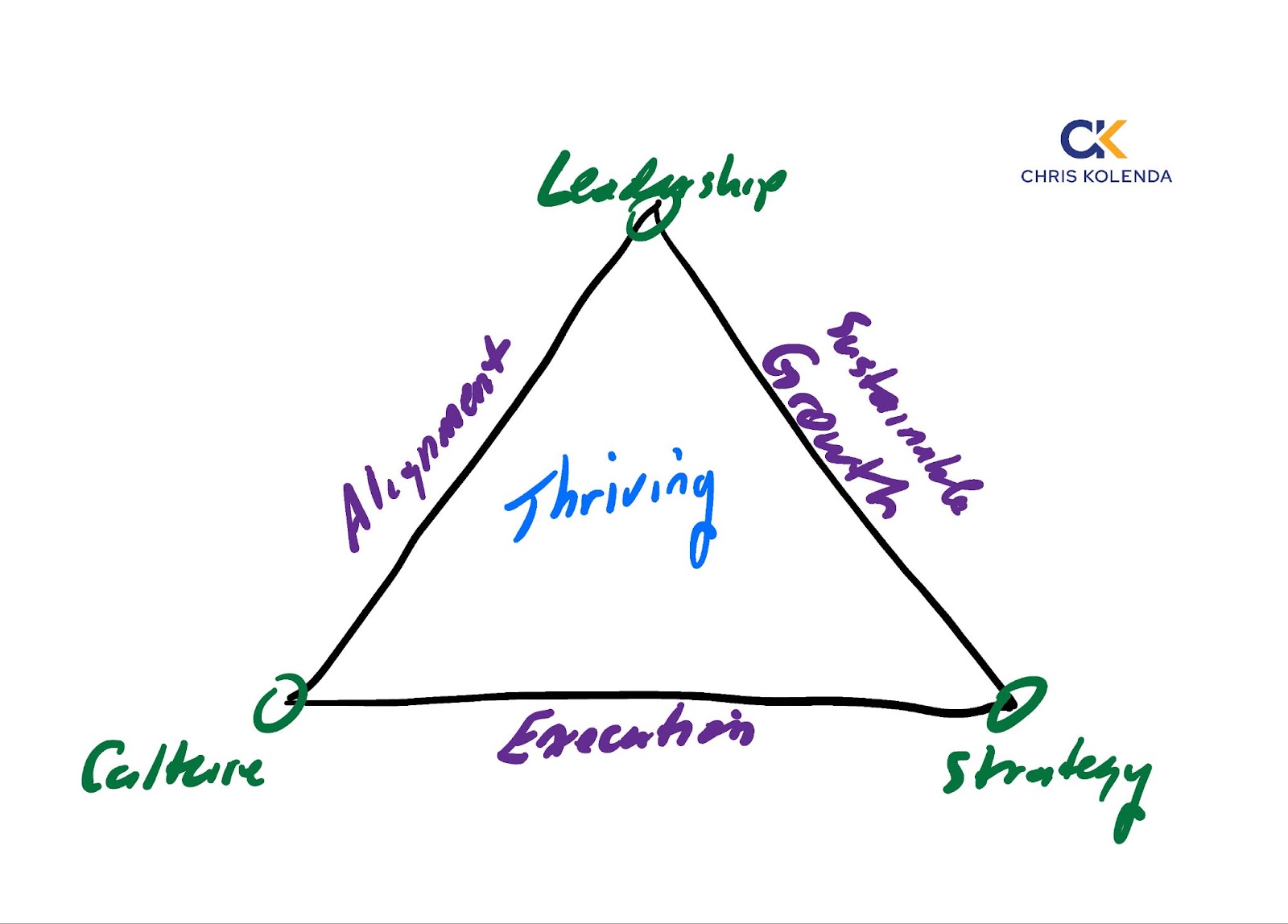
Culture and Strategy are peers alongside Leadership, and you need all three working together to succeed.

These factors are interdependent and create a framework that supports growth, resilience, and competitive advantage. 

Leadership is the driving force behind an organization’s mission and objectives. It influences the strategic direction, sets the tone for culture, and motivates employees to perform at their best.

Apple’s Steve Jobs’ clear vision was critical in driving innovation and maintaining a competitive edge.

At Wells Fargo, the creation of fake customer accounts by employees was a direct result of toxic leadership behavior that prioritized sales targets over ethical behavior, leading to widespread dissatisfaction and demotivation.

Uber experienced high turnover rates and public scandals, which highlighted a failure to address workplace harassment and discrimination.

Culture embodies the values, norms, and practices that dictate how employees interact and work together. A positive culture fosters engagement, loyalty, and productivity, ensuring the collaborative pursuit of strategic goals.

Google’s emphasis on innovation and employee well-being has enabled it to attract top talent, drive continuous innovation, and maintain high employee satisfaction.

Enron collapsed from a culture of secrecy and poor internal communication, where unethical practices were hidden from employees and stakeholders.

Blockbuster’s resistance to change and innovation prevented it from adapting to the digital streaming revolution, resulting in its downfall.

The strategy involves setting the organization’s purpose and direction and inspiring plans to achieve them so you can navigate the competitive landscape and adapt to market changes.

Amazon’s strategic focus on customer obsession, operational efficiency, and innovation has allowed it to expand rapidly and dominate various markets.

Toys “R” Us failed to address the rise of e-commerce and changing consumer preferences.

Xerox invested heavily in its PARC research center without effectively commercializing the innovations, which led to missed opportunities in the technology market.

Each element—leadership, culture, and strategy—plays a unique and essential role in an organization’s success. The absence of any one of these factors can lead to specific challenges, even if the other two elements are strong. Recognizing these indicators can help organizations identify and address their weaknesses, ensuring a more balanced and effective approach to achieving their goals.

Here’s how you can identify when one of these elements is missing.

Stagnation indicates inadequate leadership. Employees may feel directionless despite having a supportive culture and clear strategies. There is no one to inspire them toward achieving strategic goals, and no one makes bold decisions, resulting in missed opportunities.

Low Morale and High Turnover suggest you need to strengthen your culture. Even with strong leadership and a clear strategy, a toxic or weak culture can lead to employee dissatisfaction and disengagement. People will vote with their feet, and those who remain struggle with execution and performance.

A lack of focus and direction indicates that strategy is missing. Despite having inspiring leaders and a positive culture, the organization may struggle with setting and achieving long-term goals, resulting in drift, confusion, and waste.

Here’s what happens when you have all three working together. 

  • Alignment: Leadership ensures that the strategy supports the organization’s vision and that the culture advances strategic initiatives.
  • Execution: Culture drives how strategy is executed. A positive culture promotes collaboration, innovation, and commitment, which are vital for successful strategy implementation.
  • Sustainable Growth: Leadership and culture together ensure that strategic initiatives are sustainable over the long term, adapting to changes and overcoming challenges effectively.

An organization needs strong leadership to set a vision and inspire action, a positive culture to create a supportive and engaging work environment, and a clear strategy to provide direction and prioritize efforts. The absence of any one of these elements weakens the whole structure, making it difficult to achieve and sustain success. The interplay among leadership, culture, and strategy creates a synergistic effect that drives performance and ensures long-term viability.