Tag Archive for: Successful Leadership

Unwavering Inspiration: Leadership Under Fire in Business

Leadership lessons in turbulent times you can’t afford to ignore.

What do your employees truly look for in turbulent times? What encourages them to contribute their best despite the danger and uncertainty?

More than anything or anyone, they look to you. Do you exemplify the standards? Are you promoting their commitment to the common good and creating a compelling sense of ownership so that you can get through this together?

This principle is Unwavering Inspiration, which includes three main habits: 

  • Principled Conviction: To lead with integrity, you must adjust your thinking without abandoning your core.
  • Keen Judgment: To make sound choices in ambiguity, you must broaden your perspective.
  • Bold Execution: To seize advantage, you must stop waiting for perfect conditions.

3 Ways to Lead When Things Go Sideways

1. Principled Conviction: The Power of Purpose and Mission Clarity

Do you dig in your heels too hard or change direction too easily? Does the last person to speak with you gain the most influence? How about the loudest voice in the room?

Turbulent times require you to hang on to what matters most and let go of the rest. 

When Steve Jobs returned to Apple in 1997, the company was floundering. He didn’t just cut costs—he refocused everyone by holding on to what mattered most: creating beautifully designed, life-changing technology. That clarity inspired Apple’s most significant innovations.

2. Keen Judgment: Broadening Your Perspective

We don’t see the world as it is; we see it as we are. You perceive what you believe. This default mode delivers certainty that you are right and creates vulnerabilities that open you to blindsides. 

How well do you gather alternative inside views and outside perspectives? 

During the 2008 recession, Howard Schultz returned as CEO of Starbucks. Instead of making panicked decisions, he methodically restructured the business, shut down weak locations, and doubled down on quality. Even as Wall Street doubted him, his calm decisiveness kept employees and investors steady.

3. Bold Execution: Turning Setbacks Into Momentum

To seize a decisive advantage, you must stop waiting for perfect conditions. Absolute certainty is the enemy of certain enough.

How confidently do you act when outcomes are uncertain? The 80 percent solution is a good rule of thumb.

When Blockbuster rejected a partnership with Netflix, it could have been a death blow. Instead, Reed Hastings pivoted aggressively into streaming, ultimately burying Blockbuster and revolutionizing entertainment.

Final Thought

Unwavering Inspiration isn’t about cheerleading or false motivation—it’s about having the principled conviction to balance confidence and open-mindedness, deciding with keen judgment, and moving out with bold execution once you have an 80 percent solution.

P.S. When we create an adventure offsite for your leadership team at places like Antietam & Gettysburg together, you’ll gain even more battle-tested, business-proven insights. Click HERE for more details and to schedule an exclusive offsite for your team.

Project Confidence & Lead Under Fire

Great leaders know how to lead in a crisis—do you?

Crisis reveals your character. In business, just as on the battlefield, leaders set the tone. When the pressure mounts—whether from a market downturn, a major acquisition, or a crisis threatening your company’s reputation—your team looks to you. Do you show unshakable business judgment, or hesitate and equivocate?

At Antietam and Gettysburg, the greatest commanders didn’t lead from behind. They rode the front lines, making themselves visible to their troops. Leaders on horseback are the most vulnerable soldiers on the battlefield. The message was clear: if I can do my job while everyone is shooting at me, so can you. When dismounted, they led from the front. Think of Joshua Chamberlain at Little Round Top, standing firm against overwhelming odds. His soldiers held the line because they saw him do it first.

Business is no different. People take their cues from you. If you’re rattled, they’ll falter. If you’re resolute, they’ll execute. Leading under fire means setting the example, issuing clear guidance, and ensuring your people know the path forward—even when uncertainty is at its peak.

Modern Application: Alan Mulally at Ford

In 2006, Ford was in freefall—hemorrhaging billions, drowning in bureaucracy, and losing market share to foreign competitors. Then came Alan Mulally. He didn’t panic, blame external factors, or retreat behind closed doors. He projected confidence and took decisive action. His turnaround playbook? A simple strategy, empowering accountability, and sound execution.

Mulally introduced the “One Ford” plan, requiring brutal honesty in leadership meetings—executives had to bring problems to the table instead of hiding them. He kept his messaging simple and consistent: “We have a plan, and we are going to make it work.” He cut through silos, made himself present, and ensured his people knew that despite the crisis, Ford would win.

The result? Ford not only survived the 2008 financial crisis without a bailout, but emerged as a global leader again. The lesson: when your company faces adversity, your confidence and clarity set the course.

Practical Application

✔ Be visible and present. In times of crisis, don’t retreat behind reports and emails. Walk the floor, get in the field, and look your people in the eye.

✔ Control your emotions. You don’t have to have all the answers, but your demeanor must signal that you have control. Confidence is contagious.

✔ Speak with clarity and conviction. Whether it’s an internal town hall or an external investor call, people don’t just listen to what you say; they read how you say it.

Mulally possessed Courageous Insight. He was the leader on horseback, exemplifying the values, speaking plainly, and acting boldly.

Schedule a free strategy call today.

What’s Your Mission Question?

Discover the power of a mission question (and why you need one).

I listened to a podcast interview with Warren Berge, the author of The Book of Beautiful Questions, who suggested creating a mission question.

I’m intrigued by the idea, especially for innovating trailblazers. While a mission statement can focus on what you do today, a mission question expands the horizon for what you do tomorrow. 

Mission Questions That Anticipate Tomorrow’s Needs

In its heyday, Blockbuster’s mission statement was “to be the global leader in rentable home entertainment by providing customers with a wide variety of movies and games, exceptional service, and a convenient, family-friendly experience.”

The statement limited its efforts to rentable movies and games.

Imagine if Blockbuster also had a mission question: How might we best serve the evolving entertainment needs of our customers?

They might not have shut the door on streaming services. A mission question for Kodak might have opened their minds to the possibilities of digital photography.

In a dynamic marketplace like today, you need agility to position yourself to anticipate tomorrow’s needs. A mission question fosters an innovative mindset.

My Mission Question

Here’s my mission question: How might I best help trailblazing CEOs create a decisive competitive advantage so they can make an enduring transformative contribution?

This question inspires me to provide unique perspectives, experiences, content, and visual models to support your business and your aspirations.

I do this in a generalized way with newsletters, blogs, videos, and online programs.

I also support trailblazing leaders like you in a customized way through consulting and events that provide you with the best impact and return on investment.

What’s your mission question?

Strategy Call

Would you be interested in a strategy call about closing the gap between your performance and potential? A strategy call has two main objectives. First, and most importantly, is to deliver value to you. By the time we’re done, you will have gained something of significant value. It might be an idea, some perspective, or an insight into your situation.

Once we’ve had that part of the discussion and you feel that you’ve gotten that value, then we can address if and how I might be able to support you. Does that work for you?

If so, schedule a time that works for you.

What Do I Mean by Trailblazer?

Find out how to unlock your leadership potential and become a trailblazer.

A trailblazer is an exemplar of bold, visionary leadership. 

Trailblazers are not content with maintaining the status quo or following everyone else. Instead, you forge your own path, transforming obstacles into opportunities. You exude a rare combination of courage, innovation, and resilience that inspires those around you to reach higher and achieve more.

Unshakable Clarity of Purpose

Trailblazers possess an unshakable clarity of purpose. You see opportunities where others see uncertainty, navigating volatile and complex markets with a keen sense of strategy and foresight. Your ability to think several moves ahead allows you to anticipate shifts, position your companies ahead of the curve, and set the standards others strive to follow.

Cultures of Integrity and Accountability

Unwavering in their values, trailblazers create cultures of integrity and accountability. You lead by example, setting high expectations for your teams and yourself. Your teams are motivated by a shared belief in a greater mission and the trust that you will guide them to success.

Innovation

Innovation is your hallmark. You embrace change, viewing it as an essential catalyst for growth. While others may shy away from risk, trailblazers understand that calculated risks often yield the greatest rewards. You foster an environment where creativity thrives, and failures are treated as opportunities to learn and improve.

Empowerment

Trailblazers know the value of empowering others. You surround yourself with talented, diverse teams and foster collaboration to achieve groundbreaking results. You are as skilled at listening and learning as deciding and acting, creating an environment where everyone feels invested in the organization’s success.

Inspiration

Most importantly, a trailblazing leader is a source of inspiration. You don’t just lead companies—you lead movements, igniting passion and purpose in your teams and stakeholders. A trailblazer’s courage, clarity, and unrelenting pursuit of excellence set you apart as leaders who not only imagine the future but actively shape it.

In a world where success favors those who dare to lead boldly, trailblazing CEOs embody the spirit of courage and innovation, ensuring their legacies endure and their organizations thrive.

If this sounds like you, you are in exactly the right place. Schedule a strategy call with me to unlock your inner trailblazer and lead with boldness, innovation, and impact. This is a free, no-stress call. I’ll ask you questions and provide insights that you can use to strengthen your trailblazing. 

What’s in it for me? I get to learn what’s on leaders’ minds so I can make my articles and masterclasses of the highest value for you.

Reducing Confirmation Bias

Discover how to improve your decision-making by reducing confirmation bias.

I was convinced that business owners would seize the opportunity to go with me to Normandy for an executive leadership retreat. These bucket-list experiences are game-changing ways to enhance your leadership. I hired a digital marketing firm whose owner loved staff rides. 

I spent over $50k on videos, sales funnels, and ads. We got over 2 million views and 275,000 likes, but not a single buyer.

I was so convinced this retreat would sell itself that I neglected the fundamentals of identifying the ideal client, writing language that appealed to them, and describing how they would be better off. What seemed obvious to me was not so evident to my ideal clients.

What went wrong? Confirmation bias is the tendency to emphasize data confirming your point of view and dismissing contrary information. I had confirmation bias and paid a stiff price for it.

I’m not alone, of course. According to The Wall Street Journal, President Biden, egged on by his inner circle, thinks he could have won the 2024 election and served a full second term. Blockbuster dismissed mail-order videos and streaming. Kodak punted on digital photography. Robert E. Lee ordered the ill-fated Pickett’s charge at Gettysburg.

Internal Viewpoint Diversity, Bold External Perspectives, and Intense Psychological Confidence

One of the most potent ways to improve your decision-making is to reduce unforced errors. You do so by fostering internal viewpoint diversity, bold external perspectives, and internal psychological confidence.

Internal viewpoint diversity, which comes from people having different cognitive strengths and relevant experiences, enhances creativity and reduces the likelihood of groupthink. External perspectives from trusted advisers, customers, and experts help you challenge internal biases and uncover blind spots. Psychological confidence is the willingness to disagree agreeably without fear of retribution.

Missing one of these elements increases the risk of unforced errors. 

Executives entrenched in the film business dominated Kodak’s leadership team. The lack of viewpoint diversity led them to the conclusion that digital photography was only a niche market. They missed the digital boom.

Blockbuster failed to gain external perspectives, so they underestimated people’s growing preferences for convenience and on-demand services. Netflix put them out of business.

Poor psychological confidence is at the heart of Boeing’s crisis. Leaders reportedly dismissed employees’ safety concerns while emphasizing production schedules and cost efficiencies. Highly publicized problems with the 737-MAX and soddy production have damaged the company.

Lee’s overconfidence at Gettysburg resulted from the absence of all three elements. Lee’s subordinates held him in such awe that they were unwilling to question his judgment. Longstreet was the lone general who disagreed with him. Lee dismissed his concerns when no one else backed them. He had no external perspective, especially since Confederate Jefferson Davis stopped questioning Lee’s decisions. 

Had Lee recognized the risk of confirmation bias, he could have encouraged his generals to express fresh ideas and wargame alternatives. The results might have prevented the battle altogether and would have uncovered the faulty assumptions unlying Pickett’s charge. 

When you come with me to Gettysburg and stare across the mile of open ground where Pickett’s charge took place, a potent visual image of confirmation bias sears into your mind. It reminds you to ensure that internal viewpoint diversity, bold external perspectives, and intense psychological confidence inform your decisions. 

Imagine the increase in profitability when you reduce the unforced error tax.

Would you be interested in a meaningful conversation? You and I will hop on a Zoom call. I’ll ask questions to see what I see and then share insights and ideas to help you accelerate your progress.

Performance and Potential: Closing the Gap

Closing the gap between your performance and potential requires breakthrough experiences.

I used to think I could figure everything out and lone-wolf my way to success, but I could never close the gap between my performance and the potential I knew I had. 

It was frustrating. I tried reading books, watching videos, and listening to free advice that often told me conflicting things. After some early wins, my business stagnated as people lost interest in Afghanistan. 

I was going nowhere fast, wasting time and energy, and increasing the risk of failure.  

I was also doing a lot of pro bono peace-building work when I began using a movie analogy to illustrate the importance of showing people the path they cannot see for themselves.

Did you see Indiana Jones and the Last Crusade? 

Searching for the holy grail, Indy discovers the Book of Knowledge, which leads him through various obstacles to his goal. However, a vast canyon stands between him and the grail. The book tells him to take a leap of faith, so Indy steps into the gap and lands on an invisible bridge. He crosses it, then throws sand onto the bridge to illuminate it for others.

We had to illuminate the bridge that others could not see.

It was the same problem for my business, and I needed a dose of my own medicine.

Crossing the gap between your performance and potential requires a guide who can illuminate the path and help you overcome obstacles along the way. 

Content has always been my comfort zone. I knew that business development was vital, but I did not know how to market without self-promoting or sell without coming across as pushy or awkward. I believed that my content would market and sell itself.

Well, it didn’t.

I read books on marketing and sales, but I needed help applying the ideas in ways that worked for me. 

I knew where I wanted to go and what to do to get there, but I didn’t know how. I could not close the gap between my performance and potential.

It was time to invest in myself with people who could illuminate the bridge.

Sure, I could have figured things out eventually, but why waste the time, effort, and frustration in the trial-and-error hamster wheel? I could spend years discovering the right-fit practices on my own, but the right support would reveal them in days, weeks, or months. 

There’s no I-figured-everything-out-on-my-own merit badge, only lost opportunities.

Illuminating the Bridge

This chart represents the difference between your performance and potential. Your will and capacity (skill) govern your performance and create a comfort zone.

The outer band represents your potential – you can reach new heights and know the possibilities.

In between the two is the discomfort zone. It’s shrouded in fog and filled with obstacles, minefields, and frenemies. You fear this is where people watch you fall on your face, so you reinforce your comfort zone and convince yourself it’s good enough.

Fear of the discomfort zone is why so many talented people never reach their potential. 

You can also see the trial-and-error perils that await those who insist on figuring out everything themselves. 

Finding your version of Indiana Jones illuminates the bridge from performance through discomfort to potential. A breakthrough experience shows you your path forward. You still have to make the journey and deal with the hazards, but you have a partner alongside who’s made the journey and helps you deal with them in the most fitting ways.

Alan Weiss helped me develop my business in ways that worked for me and felt good. Chuck Kyle, my cycling coach, kicked my butt training for 18 months and helped me make the vital adjustments I needed to complete a 1700-mile bicycle ride to honor the six soldiers from our unit killed in Afghanistan. 

They illuminated the bridge to get me where I needed to go.

Here’s the beauty of it all. When you reach the potential you always knew you had, you discover further potential and a new adventure to realize it.

Are you ready to break through your comfort zone and achieve the outcomes you deserve? If so, it’s essential to find the right fit for you.

2 Breakthrough Experiences

I’ve got two breakthrough experiences I’d like to share with you: one for CEOs and one for professional services entrepreneurs.

For CEOs: the Antietam & Gettysburg experience gives you new tools and stories to make pivotal decisions, create the supportive culture your company needs to thrive, and the leadership behaviors that gain buy-in and accountability. You’ll enjoy this breakthrough experience with other extraordinary CEOs and build lasting, mutually supportive bonds.

For professional services entrepreneurs: the December 11-13 Business Strategy Breakout Program is an intimate, hands-on, roll-up-your-sleeves, work-on-your-business, and get-results summit for coaches, consultants, experts, thought leaders, and other game changers. Its goal is to help you close the gap between your performance and potential—and realize even greater potential—without sacrificing your lifestyle and commitments in the process.

If one of these opportunities feels right for you, let’s have a meaningful conversation to make sure it’s a good fit. We’ll discuss your performance and potential, and I’ll give you action steps that start closing the gap, whether or not we decide to take the next step.

Improve Performance with Supportive Criticism

Here’s how supportive criticism can transform your team’s success.

Accountability’s purpose is to improve future performance. The results are readily apparent: employees meet standards, work together well, increase productivity, manage conflict, and delight customers, among other advantages.

It’s challenging to get right. There’s a good chance your subordinate leaders fall into one of two camps that undermine accountability. 

Is this topic important to you? Read on to find a fresh approach to accountability that improves future performance without awkwardness.

The 2 Unhealthy Common Approaches

Some leaders opt for the authoritarian style reminiscent of George C. Scott’s portrayal of General George S. Patton, Jr., in Patton: you make people fear you more than they fear failure, you make enormous demands, accept no excuses, chew people out, and rake them over the coals for past mistakes. 

That approach worked poorly for the real Patton, who Eisenhower fired for assaulting his own soldiers in Sicily. Patton learned his lesson, and his legendary victories after D-Day were attributable, in part, to better accountability practices. 

Others take the so-called servant leader approach, reducing their demands on employees by taking more of the burden themselves, avoiding confrontation, letting people set their own standards, and picking up the slack because they believe every failure or shortfall is their fault. 

Authoritarians have significant challenges with employee dissatisfaction and turnover, while servant leaders have burnout. Neither approach improves future performance.

What’s Wrong with How They Provide Feedback

The feedback sandwich is a common approach between the two: you try to soften the impact by saying something positive about the person, providing “constructive criticism,” and ending on a high note with more affirmation. 

This exchange between Henry and his boss, Mary (not their real names), is a typical example.

Henry, I appreciate your work here. I want to give you some feedback. You are not anticipating needs very well, and we always seem to scramble at the last minute, especially before major events and board meetings. You are supposed to go on two weeks of vacation in three days and have yet to frame the read-ahead due two weeks after you return. What you have in the shared folder is poorly formatted and not acceptable. Overall, though, you are doing great work.

What do you think about this exchange? Chances are very high that you’ve either given or received this type of feedback. 

Mary used the session to unburden her frustrations and felt better about it by sandwiching the criticism with praise.

Henry was demoralized. He concluded that Mary believes him incompetent and wants to get rid of him. He’s frustrated because Mary hasn’t set clear expectations, and their recent exchange hasn’t given him any ways to improve his performance. Just because you tell people what they are doing wrong does not mean what right looks like is apparent to them. The empty praise on either end seems disingenuous and reinforces his belief that you want to fire him.

The sins of the past focus is the biggest shortcoming of so-called constructive criticism. 

Yet, sometimes, you must highlight what went wrong with past performance to illustrate the impact and contrast it with standard-meeting performance.

How do you thread that needle?

Supportive Criticism: A 5-Step Process

Here’s a different approach, which I’m calling supportive criticism. It’s a five-step process.

  1. Note the shortfall and express confidence, “Waiting until the last minute to prepare the meeting document impedes coordination and performance. My standards for a read-ahead are very high, and I know you can meet them.”
  2. Discuss the impact: “We are inadequately prepared for the meeting because we’re making constant last-minute changes, the late read-ahead and formatting errors undermine our credibility, and we’re not getting the decisions we need from the board.”
  3. Here’s how to do it better next time.
  4. Here’s what I’m going to do to help you be successful.
  5. What does ideal support look like?

Here’s how a supportive criticism conversation could go.

Henry, I want to discuss the recent board read-ahead documents because they do not meet our quality and timeliness standards, and I am confident you can meet them (1). 

When the read-ahead is late and poorly formatted, we look unprofessional and don’t set the meeting up for success. We have to give people extra time to read the document, which reduces the discussion and coordination, and we have to punt too many decisions later, which slows our ability to get things done (2).

Next time, I’d like to see a final read-ahead copy two weeks before the meeting so we can do a final quality check, get the material in front of the board on time, and conduct pre-coordination on the key decisions (3). 

I recognize I need to do a better job of setting you up to be successful. To improve clarity, I will use the “X so that Y by when” format so you know what needs to be done, the results and outcomes I’m looking for, and the deadline. Second, let’s coordinate two check-ins beforehand so you can raise questions, show progress, and identify areas where you need additional support (4). Third, you take on a tremendous amount of work, so I want to use our weekly check-ins to ensure we’re aligned on priorities and that I’m not overloading you. What else does ideal support for you look like (5)?

Do you feel the difference in the two approaches? If you were Henry, which one would inspire you? 

Supportive criticism shows Henry what’s short of the mark, how he can do it better, and how you will help him be successful (without doing it for him like many “servant leaders” would do). 

Try this approach on for size, and let me know how it’s working for you.

I write these articles to give you the tools and action steps that get results. Although we had several leadership classes in the military, the vast majority focused on theories and principles. They all sounded good, but I often stumbled without the conscious processes to implement them. 

To help you avoid my errors, I provide you with tools (like Supportive Criticism) that turn theory into practical application. The more value you gain for free, the more likely you are to discuss ways to accelerate your success. Your commitment to getting good at getting better makes you the kind of person who’s a joy to support.

Do you want to discuss supportive criticism approaches further? Book a call.

The Power of Rewarding Innovative Behaviors

Swedish beach volleyball shows the power of rewarding innovative behaviors.

How can you promote innovation? Look for three behaviors.

Sweden’s Olympic Men’s Beach Volleyball duo, David Ahman and Jonatan Hellvig, are short for the sport. Most male beach volleyballers reportedly average 6 feet 7 inches, four inches taller than Ahman and Hellvig.

Height and jumping ability are huge advantages because you can spike over your opponent’s reach. Until now, the arms race in men’s beach volleyball has been jump height. No matter how hard Ahman and Hellvig work on their glutes, they will not out-reach someone of similar power four inches taller.

They needed to innovate, creating an advantage where none existed before. The jump-set is their response.

Volleyball’s typical rhythm is bump-set-spike. You bump the opponent’s shot into the air, and your teammate sets the ball in position for you to spike it.

Everyone knows the spike comes on the third touch, so your opponents try to block your spike at the net, timing their jump to yours. Hence, the jump height advantage.

What if you could fool your taller opponent into either staying on the ground and not contesting your spike or committing too early and being out of position to your teammate’s spike?

The key, they discovered, was touch #2. Instead of predictably setting for the spike, the setter would jump into the air and either spike or set based on their opponent’s reaction. It’s just like the option play in football, where your opponent’s actions provide the cues for your decision.

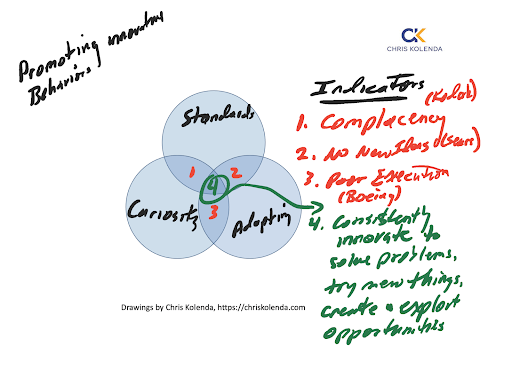
What strikes me about this example is the power of rewarding innovative behaviors. Ahman and Hellvig cannot control that their jump height will not equal their opponent’s, but they can control three behaviors that promote innovation: maintaining high standards, demonstrating curiosity, and being willing to adapt.

In terms of execution, their performance and behavioral standards are exemplary, or they wouldn’t be competitive. They are students of the game, learning that touch #2 was where they could offset their opponent’s jump height advantage (curiosity). They innovated with the jump set on touch #2 to exploit the tactical dilemma they created (adapting).

Chart on promoting innovative behaviors.

Standards, Curiosity, and Adapting: You Need all 3 to Compete Effectively.

Without standards, you won’t perform at high levels consistently, as recent challenges at Boeing show. You don’t learn without curiosity, so you get stuck in ruts; just ask Sears, who failed to examine how information technology would change the marketplace. Unwillingness to adapt suggests complacency: you will miss opportunities like Kodak did after inventing and rejecting the digital camera.    

If you want to find the employees most likely to help your company grow, look for people who show high standards, curiosity, and a willingness to adapt.

Avoid rewarding people based on outcomes. Doing so could reward (or penalize) luck and factors outside their control while reinforcing bad behavior.

Do you want to discuss strategies for rewarding innovative behaviors? Book a call.

The Problem with “Servant Leadership”

There are many reasons for increased manager burnout. I want to call attention to a particularly pernicious problem: servant leadership.

Like many people, especially in the military, I regarded “servant” as the highest form of leadership [selfless service is one of the Army’s values.]. 

After all, leading includes service to a higher purpose, the organization, and the people in it. Seventy percent of Fortune 500 companies reportedly say they practice servant leadership.

Well, servant leadership burned me out. 

I was wrong to advance an unexamined piece of conventional wisdom, and I encourage you to rethink it and focus simply on being a good leader.

Do you worry about burnout? You are not alone. According to Harvard Business Review, over 50% of managers feel burned out. 

Burned-out managers exhibit behaviors that degrade their performance, well-being, and the overall health of their teams and organizations. These include:

  • Decreased productivity
  • Increased irritability
  • Poor decisions
  • Self-neglect
  • Lower creativity
  • Less appreciation of employee efforts
  • Increased absenteeism
  • Poor communication

According to Merriam-Webster, a servant is “a person in the employ and subject to the direction or control of an individual or company.” A servant lacks agency. The implications are significant.

Ripe for Abuse. Almost anything goes when “the cause” is the highest good. 

“I want you to stay until 10 pm tonight to work on this presentation.” 

“But it’s my anniversary, and I promised to go to dinner with my wife.”

“I’m sorry about the timing. I really need you to work on this. You are a servant leader in this company, so you have to sacrifice for the greater good.”

Reliance on selfless service and servant leadership is a common way to cover up poor planning, sloppy time management, bullying, and other dysfunctional behaviors.

No Boundaries. As a selflessly serving servant, you have to be “on” at all times. Responsiveness is vital. When your boss texts you at 11 pm on Saturday night, you had better reply within minutes.

Dinner with your family? Storytime with your kids? Softball game? You’d better have your phone ready to answer your boss’s call.

When one of your employees is stressed out, you take on their emotional burdens and workload. You’ll do anything to serve your people.

Constantly prioritizing the needs of others emotionally and physically drains you. That’s what your company demands when they tell you to be a servant leader.

Denial of Self. There can be no self for those who serve selflessly. As a servant leader, you are expected to neglect your own well-being because everyone and everything else comes first. You need to go everywhere, do everything, be everyone for everyone. 

I’ve lived this life, and it costs me and my loved ones. I thought it was the price of being a leader. I tried not to pass on this mentality to my direct reports, encouraging them to set boundaries and take care of themselves, but my personal example sent mixed messages.

Yes, serving is part of leading, but so are requirements like making tough decisions, enforcing standards, and firing people. It can be exhausting, and you need to be vigilant about your capacity and energy to lead the way your company and people deserve and to be the kind of parent, sibling, friend, etc., that your loved ones deserve. 

Here’s What to do instead

Be a leader; forget the label. Use your judgment. Focus on being a good leader who inspires people to contribute their best to your organization’s success. Sometimes, the good of the organization comes first; other times, the needs of the individuals rise to the top. As I note in Leadership: The Warrior’s Art, Be trustworthy, treat people with respect, and be a good steward of your company.

Encourage the Gas Mask Principle. When facing a drop in cabin pressure or a chemical attack, apply your mask before attempting to help others. Otherwise, you put yourself and the person you are trying to help at greater risk. Spend time with your loved ones, sleep, eat right, exercise, and do important things outside of work. Encourage your employees to do the same.

Co-create boundaries that you and your direct reports respect. My mentor, Michèle Flournoy, explained how she and Secretary of Defense Robert Gates did this together and its impact on her and her family. Gates famously left the office by 5:30 pm daily because he knew that staying late encouraged others to do so, even if they had little to do but be seen. 

Provide Perspective. Most matters can wait until the next morning or next week. If you have to write that email tonight to get it off your mind, time it to send tomorrow morning. By sending it tonight, you encourage people to respond tonight. You won’t sprint your way to completing a marathon.

Manage Exceptions. There are rare times when you need that late night. When you respect boundaries and encourage people to take care of themselves and have a life outside their work, they will rise to the occasion when a crisis hits, and you need all hands on deck.

Your Culture Doesn’t Eat Anything for Breakfast

The saying, “Culture eats strategy for breakfast,” attributed to Peter Drucker, suggests culture is your top priority. 

You know culture is important to cultivate, but where should it rank among your priorities in leading your organization and strengthening its purpose and direction? 

I love taking on popular nonsense, and this one needs addressing. 

Culture doesn’t eat breakfast, and it certainly doesn’t eat strategy.

Culture and Strategy are peers alongside Leadership, and you need all three working together to succeed.

These factors are interdependent and create a framework that supports growth, resilience, and competitive advantage. 

Leadership is the driving force behind an organization’s mission and objectives. It influences the strategic direction, sets the tone for culture, and motivates employees to perform at their best.

Apple’s Steve Jobs’ clear vision was critical in driving innovation and maintaining a competitive edge.

At Wells Fargo, the creation of fake customer accounts by employees was a direct result of toxic leadership behavior that prioritized sales targets over ethical behavior, leading to widespread dissatisfaction and demotivation.

Uber experienced high turnover rates and public scandals, which highlighted a failure to address workplace harassment and discrimination.

Culture embodies the values, norms, and practices that dictate how employees interact and work together. A positive culture fosters engagement, loyalty, and productivity, ensuring the collaborative pursuit of strategic goals.

Google’s emphasis on innovation and employee well-being has enabled it to attract top talent, drive continuous innovation, and maintain high employee satisfaction.

Enron collapsed from a culture of secrecy and poor internal communication, where unethical practices were hidden from employees and stakeholders.

Blockbuster’s resistance to change and innovation prevented it from adapting to the digital streaming revolution, resulting in its downfall.

The strategy involves setting the organization’s purpose and direction and inspiring plans to achieve them so you can navigate the competitive landscape and adapt to market changes.

Amazon’s strategic focus on customer obsession, operational efficiency, and innovation has allowed it to expand rapidly and dominate various markets.

Toys “R” Us failed to address the rise of e-commerce and changing consumer preferences.

Xerox invested heavily in its PARC research center without effectively commercializing the innovations, which led to missed opportunities in the technology market.

Each element—leadership, culture, and strategy—plays a unique and essential role in an organization’s success. The absence of any one of these factors can lead to specific challenges, even if the other two elements are strong. Recognizing these indicators can help organizations identify and address their weaknesses, ensuring a more balanced and effective approach to achieving their goals.

Here’s how you can identify when one of these elements is missing.

Stagnation indicates inadequate leadership. Employees may feel directionless despite having a supportive culture and clear strategies. There is no one to inspire them toward achieving strategic goals, and no one makes bold decisions, resulting in missed opportunities.

Low Morale and High Turnover suggest you need to strengthen your culture. Even with strong leadership and a clear strategy, a toxic or weak culture can lead to employee dissatisfaction and disengagement. People will vote with their feet, and those who remain struggle with execution and performance.

A lack of focus and direction indicates that strategy is missing. Despite having inspiring leaders and a positive culture, the organization may struggle with setting and achieving long-term goals, resulting in drift, confusion, and waste.

Here’s what happens when you have all three working together. 

  • Alignment: Leadership ensures that the strategy supports the organization’s vision and that the culture advances strategic initiatives.
  • Execution: Culture drives how strategy is executed. A positive culture promotes collaboration, innovation, and commitment, which are vital for successful strategy implementation.
  • Sustainable Growth: Leadership and culture together ensure that strategic initiatives are sustainable over the long term, adapting to changes and overcoming challenges effectively.

An organization needs strong leadership to set a vision and inspire action, a positive culture to create a supportive and engaging work environment, and a clear strategy to provide direction and prioritize efforts. The absence of any one of these elements weakens the whole structure, making it difficult to achieve and sustain success. The interplay among leadership, culture, and strategy creates a synergistic effect that drives performance and ensures long-term viability.