Tag Archive for: Trump

What Trump’s Tariffs Reveal About Innovation

Trump’s tariffs and Captain Tom Bostick’s battlefield strategy illustrate two contrasting approaches to innovation.

A large enemy force tried to overrun our small outpost near Kamu, Afghanistan. The outpost was deep in a glacier-cut mountain valley. The enemy fired at the outpost from across the river, trying to fix our attention, while a strike force moved from the southwest.

The commander, Captain Tom Bostick, deployed scouts who discovered the attacking force. Tom set an ambush and annihilated them before turning his attention across the river.

He thought the enemy had their command post in a mountain cave overlooking the outpost. He directed 30mm cannon fire from the A-10 Warthog to the cliff face. “They are shooting above us,” the enemy commander said over the walkie-talkie, which Tom’s interpreter monitored.

Tom directed the aircraft to fire higher up. “They are shooting below us,” announced the excited voice. Tom and the A-10 pilot had the enemy bracketed. The pilot spotted the cave, spewing 30mm into it while his wingman lined up a 500lb bomb. 

“Pray for us,” was the enemy’s last transmission.

Tom used reconnaissance by fire to reveal the enemy’s location before dropping the remaining 500lb bomb. 

Trump’s Tariff Policy: The Opposite Approach

President Trump’s tariff policy takes the opposite approach. Massive Liberation Day tariffs roiled markets. The President paused them, then imposed more. The exceptions and exemptions seem to roll out daily. 

There are excellent reasons to impose tariffs. The big strike and chaotic back-and-forth create an impression of incompetence, but everything may work out.

The examples illustrate two approaches to innovation. Tom’s approach was to use small bullets to test the market, so to speak, before dropping the big bomb.

President Trump’s tariff policy drops the big bomb first and adjusts based on the fallout.

Which approach is better for your business?

P.S. Innovation is one of the many topics we can explore on an adventure offsite for your company. These offsites at national parks and historic battlefields open minds and strengthen trust because you are in the fresh air, experiencing awe, and creating shared visual models that propel your business forward.

Sound interesting? Let’s have a strategy call to see if it’s right for you.
Analyzing the Downstream and Upstream Actions of Secret Service Agents in Protecting Trump

Secret Service breakdown at Trump rally shows the importance of upstream thinking.

I’m appalled by the assassination attempt on former President Trump, and I cannot help but think the violent rhetoric that’s entered our political discourse played a role. I hope people think more carefully before characterizing their opponents in existential terms.

As we get some distance from the event, I wanted to highlight the bravery of the Secret Service agents who did as they trained and protected Trump with their lives. The following bullet, had it been fired, would have hit one of them, wounding or possibly killing them. Thank goodness that did not happen. 

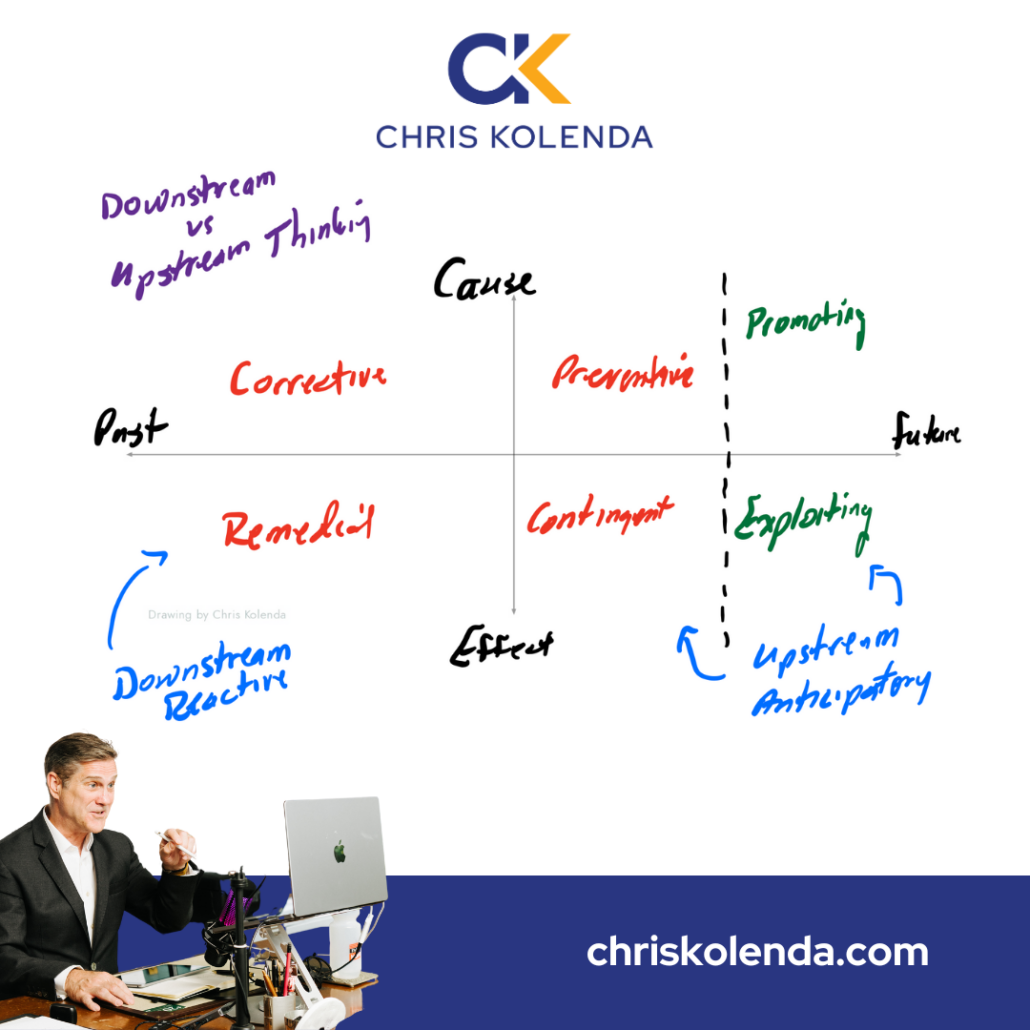
Their actions in response to the event were classic examples of corrective (killing the assailant) and remedial action (protecting Trump). These are downstream actions – reactions to something that already occurred. 

How was someone able to climb up a nearby building with a firearm and set up a firing position without being challenged or interdicted before being able to shoot? People reportedly noticed the assailant and tried to warn authorities for many minutes beforehand.  

Upstream vs. Downstream Thinking

The event suggests the Secret Service’s upstream action was inadequate. Some upstream actions avert adverse events or provide contingencies, while others promote or exploit positive possibilities. 

Preventive action, for example, is designed to prevent something from happening, like providing people with steps to safeguard campfires so they don’t become forest fires. A simple line-of-site tool could show the places with direct sites to the podium so you could place security or surveillance up to a certain distance. Drones could patrol overhead, and counter-drones could keep out intruders. Having security personnel easily identifiable also provides deterrence. 

Contingent actions, which you use to generate options in case a shooter emerges, could include easy reporting protocols (like sports stadiums use for people to report bad behavior), information sharing, and quick reaction forces. I hope an investigation gets to the ground truth and the Secret Service uses the experience to prevent another such attempt.

The takeaway for your business is to create a habit of upstream thinking—crisis prevention is less dramatic than crisis response and almost always less expensive. 

Fortunately, upstream thinking is a learnable skill that I can help you develop. It positions you to reduce risks and exploit favorable opportunities, putting you a step ahead of everyone else. Book a call with me to discuss ways to use upstream thinking.