Tag Archive for: psychological confidence

Building a Psychologically Confident Workforce

Discover how to build a psychologically confident workforce that drives innovation and performance.

Did you know that half of the workforce keeps their best ideas to themselves, while only a third feel heard? 

Imagine the impact on your organization when everyone offers their best ideas for solving problems and imagining new possibilities.

What happens at the white line is critical to this transformation. Leaders create a psychologically confident environment by taking three actions.

Graph on being psychologically confident.

The 3 Vital Elements of Psychological Confidence

1. Feel Encouraged

Leaders actively encourage people to speak honestly, identifying problems promptly and offering innovative ideas to enhance their work.

  • ✅ Toyota empowers assembly-line workers to stop production if they spot a problem. They celebrate the employee’s action, even if they were incorrect about the problem. Promoting the behaviors is vital for success. If they only applauded the action if the employee was right, fewer would take the risk, and minor problems would morph into big, costly ones.

This culture of encouragement has made them global quality leaders. 

  • ❌ In contrast, Boeing’s recent challenges reportedly stem from managers shifting their focus from quality to production volume. They allegedly discouraged employees from flagging problems, resulting in a series of costly in-flight problems.

Action: Reward the behaviors you want to promote. 

2. Feel Respected

Leaders treat people with dignity and promote agreeable disagreement. They provide agency with sensible boundaries and encourage people to use their judgment. 

  • ✅ During Southwest Airlines’ heyday, employees were trusted to make judgment calls. That trust, rooted in mutual respect, built unity across the company.
  • ❌ At Uber (pre-2017), internal disrespect and a toxic culture led to lawsuits, resignations, and a complete brand overhaul.

Action: Stop dismissive behavior in its tracks. Acknowledge every contribution. 

3. Feel Heard

People know their voice makes a difference. Leaders practice “Listening to Understand” so their employees have tangible evidence that their voice is heard and understood.

  • ✅ At Pixar, feedback from anyone can shape the creative process. That’s why their storytelling is world-class.
  • ❌ At Wells Fargo, employees raised alarms about unethical pressure to meet sales quotas. They were ignored—or punished. That silence cost the company billions in fines and damaged its reputation.

Action: Use the 3-step Listening to Understand process. Follow up. Highlight team input when decisions are made.

What Happens When One Element Is Missing?

Here’s how the system breaks down:

Table on being psychologically confident.

Each element is a leg of the stool. Remove one, and the whole thing collapses.

We’ll discuss these steps in my next masterclass, Building Psychological Confidence in Your Workforce, which takes place on June 12 at 11:00 a.m. U.S. Central Time.

As always, these sessions are not lectures, but workshops where you develop practices you can implement immediately.

What Happens When Your Team Doesn’t Speak Up?

Want a stronger culture? Start by encouraging disagreement and speaking up.

“Insurgents who reintegrate (i.e., agree to join the Afghan government) will become local police,” the general announced. “Just like Iraq. Are there any questions?” 

Senior officers around the table nodded in agreement. A few guessed what would happen next: bands of thugs would claim to be Taliban fighters, agree to “reintegrate,” and then become U.S.-funded, Afghan government-sanctioned thugs.

There was no point in speaking up again. No one was listening. 

Sure enough, the well-intentioned program created more predatory behavior and disillusionment with the Afghan government.  

Have you ever left a meeting feeling like people were holding back?

You asked for input. You gave space. But something wasn’t landing—and no one said what needed to be said.

I’ve seen the cost of this silence in the military and business: missed risks, unforced errors, lost innovation, and disengagement. And the cause is often invisible. It’s not a lack of intelligence, resources, or skill. It’s a breakdown in something deeper: Psychological Confidence.

Chart on psychological confidence and speaking up.

What Is Psychological Confidence?

Psychological Confidence is the shared belief that people can speak openly, be treated with respect, and know their voices matter, without fear of embarrassment, punishment, or being ignored.

It’s not about making everyone feel comfortable all the time. It’s about cultivating an environment where truth can be spoken, especially when it’s inconvenient, and where leaders invite challenges instead of being surprised by them.

This is the active engine behind high trust, initiative, and innovation. It lives at the intersection of three vital elements:

  • Speak Openly
  • Be Respectful
  • Feel Heard

Next week, I’ll break these down with real-world examples—what happens when these elements are strong, and what happens when they’re missing.

Case Study

A manufacturing company promoted open and respectful dialogue on challenging issues, and we trained people in ways to resolve conflict and disagree agreeably.

They were confident in addressing their declining profitability.

During a strategy workshop, the leaders identified that waste and rework were the heart of the problem, so they implemented a system that defined what jobs met their standards. Anything outside of those parameters would require senior leader approval.

Today, profitability is rising, which allows the company to pay bigger bonuses and attract better talent.

Psychological Confidence doesn’t happen by accident. It’s built—intentionally—through consistent, visible leadership.

This isn’t about being soft. It’s about being strong enough to foster truth, respect, and initiative in the people you lead.

When your team has Psychological Confidence, you’ll see fewer blind spots, more decisive execution, and a culture that sharpens itself over time.

The question isn’t just: “Do my people feel safe?”

It’s: “Do they feel confident enough to speak up—and know it will matter?”

That’s the kind of culture that wins in the long run.

Are you ready to strengthen your company’s psychological confidence? 

If so, I invite you to join my Building Psychological Confidence masterclass on June 12th at 11 a.m. U.S. Central Time via Zoom. The fee is only $49 through May 31, and then it goes to $97. 

All registrants get the video recording and visual models.

Boosting Psychological Confidence

Psychological confidence arises when people are willing to speak up without fear of retribution; they do so respectfully and are confident they’ll be heard.

I prefer this term over psychological safety because safety-ism has created an expectation that employees should be free from accountability. Psychological confidence is about the courage to speak up and listen with an open mind, not about trigger warnings, safe spaces, and microaggressions.

People with psychological confidence report problems immediately, offer you fresh ideas that improve your business, and responsibly try new things that make your people, processes, and products work better. 

You don’t get innovation without psychological confidence.

According to an Accenture study that cites Gartner, HBR, and Gallup, companies with high psychological safety (confidence) experience:

27% lower turnover

76% higher engagement

50% more productivity

Your employees experience:

74% less stress

67% willingness to try new things

29% more life satisfaction

All three elements are vital for psychological confidence. Employees who fear retribution for disagreeing with their boss will keep problems and ideas to themselves, just like the co-pilot on the ill-fated Air France flight 447. 

The inability to disagree agreeably promotes gaslighting – employees will stay silent to avoid being blasted by a colleague. Such self-censoring is rampant on college campuses. 

Finally, no one will waste the effort to speak up if they don’t believe you’ll take them seriously; exhibit A is FTX’s collapse.

Magic happens when all three elements are working together. The willingness to speak up and disagree agreeably creates open-mindedness. Speaking up and believing you’ll be taken seriously creates confidence, and agreeing disagreeably while knowing you’ll be taken seriously builds trust.

Open-mindedness, confidence, and trust are the heartbeat of psychological confidence, creating the abundance mentality to share wisdom and co-create, leading to innovation.

To help you assess the degree of psychological confidence in your organization, Dr. Mark Goulston and I developed a survey that produces your Net Psychological Confidence Score.  

You can take it here as an individual to gauge your personal level of confidence. We can also create a version customized for your organization.

You’ll gain:

  • Your organization’s Net Psychological Confidence score, which you can use as a baseline for gauging progress.
  • Knowledge on what factors are playing the most significant role in your score.
  • Follow-up videos and action steps you can use immediately to strengthen your organization’s psychological confidence.
  • Greater trust, more innovation, lower turnover, and less stress as you implement these steps. 

Check out the survey here, and email me or schedule a call if you’d like to see if your Net Psychological Confidence Score is a good fit for your organization.

Building Psychological Confidence in a Hyper-Safe Workforce

Psychological confidence is the willingness to speak up respectfully, with the confidence of being taken seriously.

Why it matters

Organizations with high levels of psychological confidence have 27% lower turnover, 74% higher engagement, and 50% more productivity. All of this even as employees report significantly higher life satisfaction (29%), lower stress (74%), and more willingness to try new things (67%).

I prefer psychological confidence over psychological safety because safety-ism has become an excuse never to hear anything you disagree with. You have people (many on college campuses) to whom any constructive criticism (or an A-) makes them feel “unsafe.” This condition is psychological fragility and requires therapy.

In psychologically confident companies, employees will report problems before they become crises, share fresh ideas that will improve your business, and challenge facile thinking.

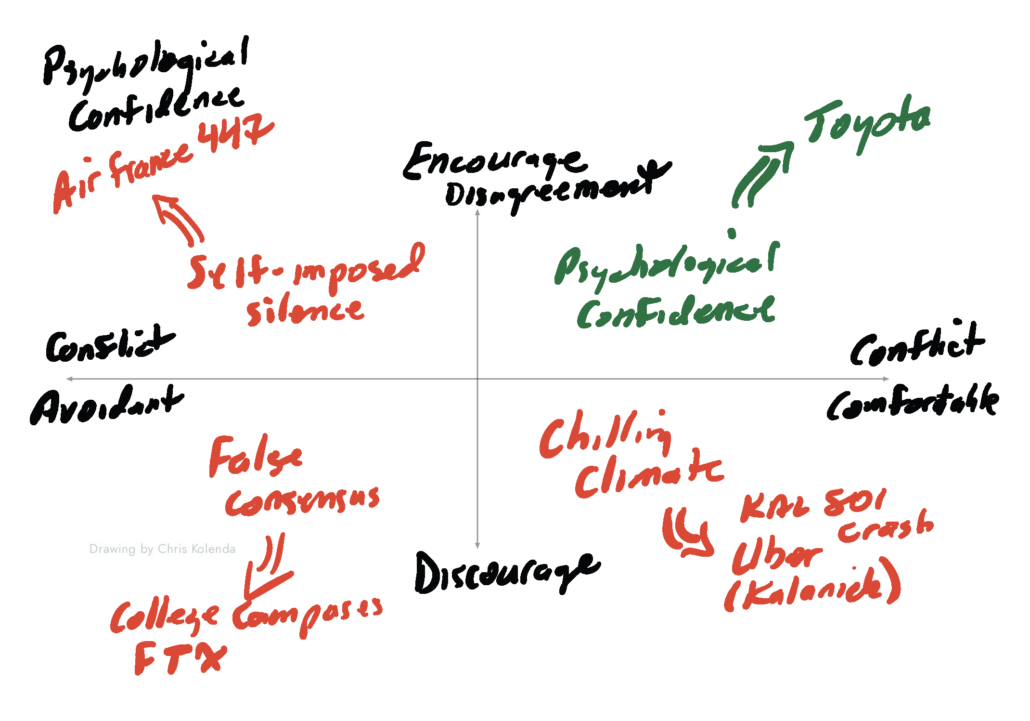
The chart below compares states of psychological confidence. The north-south axis depicts whether leaders encourage or discourage respectful disagreement, while the east-west axis contrasts conflict-avoidant employees versus conflict-comfortable ones.

Psychological confidence

Leaders may encourage disagreement, but employees who are conflict-avoidant will remain silent. The Air France 447 co-pilot knew what to do but was unwilling to assert himself; the crash in 2009 killed 228 people.

False consensus occurs when leaders discourage disagreement and conflict-avoidant employees self-censor. Many college campuses have this problem. The crypto-company FTX did too. Employees knew of problems, the founder did not want to hear them, and investors lost billions.

Conflict-comfortable employees may face a chilling climate when leaders discourage disagreement. Uber’s co-founder Travis Kalanick created a toxic work environment that prompted top talent to leave and report his misbehavior. Uber’s valuation dropped in half, a loss of $35b. Korean Airlines 801 faced a similar situation: the captain ignored the co-pilot’s warning to follow proper procedures. The crash killed 228 of 254 on board.

The best companies have psychological confidence; leaders encourage respectful disagreement, and employees share their views. Toyota is a super example: any employee who sees a problem can pull the stop lever to halt production. Its Kaizen continuous innovation model encourages people to share ideas and try new things. The trick here is to avoid complacency and backsliding.

Where does your company stand?

I can help you boost your company’s psychological confidence if you are not where you want to be, or if you want to avoid complacency and backsliding.

When you get good at getting better, you can achieve big goals in the simplest way possible.

schedule a call with chris
Founder's forum