 (571) 303-8096
 chris@chriskolenda.com


The Power of Rewarding Innovative Behaviors
Swedish beach volleyball shows the power of rewarding innovative behaviors.
How can you promote innovation? Look for three behaviors.
Sweden’s Olympic Men’s Beach Volleyball duo, David Ahman and Jonatan Hellvig, are short for the sport. Most male beach volleyballers reportedly average 6 feet 7 inches, four inches taller than Ahman and Hellvig.
Height and jumping ability are huge advantages because you can spike over your opponent’s reach. Until now, the arms race in men’s beach volleyball has been jump height. No matter how hard Ahman and Hellvig work on their glutes, they will not out-reach someone of similar power four inches taller.
They needed to innovate, creating an advantage where none existed before. The jump-set is their response.
Volleyball’s typical rhythm is bump-set-spike. You bump the opponent’s shot into the air, and your teammate sets the ball in position for you to spike it.
Everyone knows the spike comes on the third touch, so your opponents try to block your spike at the net, timing their jump to yours. Hence, the jump height advantage.
What if you could fool your taller opponent into either staying on the ground and not contesting your spike or committing too early and being out of position to your teammate’s spike?
The key, they discovered, was touch #2. Instead of predictably setting for the spike, the setter would jump into the air and either spike or set based on their opponent’s reaction. It’s just like the option play in football, where your opponent’s actions provide the cues for your decision.
What strikes me about this example is the power of rewarding innovative behaviors. Ahman and Hellvig cannot control that their jump height will not equal their opponent’s, but they can control three behaviors that promote innovation: maintaining high standards, demonstrating curiosity, and being willing to adapt.
In terms of execution, their performance and behavioral standards are exemplary, or they wouldn’t be competitive. They are students of the game, learning that touch #2 was where they could offset their opponent’s jump height advantage (curiosity). They innovated with the jump set on touch #2 to exploit the tactical dilemma they created (adapting).
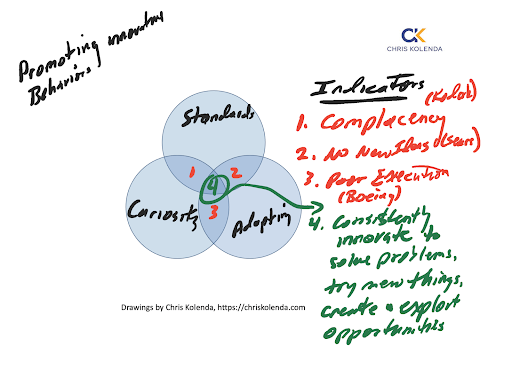
Standards, Curiosity, and Adapting: You Need all 3 to Compete Effectively.
Without standards, you won’t perform at high levels consistently, as recent challenges at Boeing show. You don’t learn without curiosity, so you get stuck in ruts; just ask Sears, who failed to examine how information technology would change the marketplace. Unwillingness to adapt suggests complacency: you will miss opportunities like Kodak did after inventing and rejecting the digital camera.
If you want to find the employees most likely to help your company grow, look for people who show high standards, curiosity, and a willingness to adapt.
Avoid rewarding people based on outcomes. Doing so could reward (or penalize) luck and factors outside their control while reinforcing bad behavior.
Do you want to discuss strategies for rewarding innovative behaviors? Book a call.
